

Go from bare plastic to a museum-shelf finish — the exact priming-to-weathering sequence pro builders never skip.
Finishing model airplanes is the stage where a build either earns its place on the shelf or gives away every shortcut you took along the way. You can assemble a kit cleanly and still end up with something amateur: streaky paint, silvered decals, chalky panel-line washes, and mismatched sheen all signal a builder who skipped a step or ran the sequence out of order.
The good news is that the fix is a repeatable sequence, not a secret talent. Modeling author Mike Ashey, in Building and Detailing Scale Model Aircraft, describes assembly, painting, and decaling as the core skills — the “triangle of success” — for scale model building. Done in order, these three skills leave a finished model with no seams, no surface flaws, and decals that sit down tight without silvering.
This guide lays out that routine end to end — surface preparation through final reassembly — and it works on any plastic scale model aircraft kit, in any scale. Every step depends on the one before it: follow the order and the finish is reachable; skip a step and the problem compounds. The techniques draw on published expertise in FineScale Modeler, professional reference books on airbrushing, priming, and decaling, and the judged-competition knowledge of the IPMS/USA (International Plastic Modelers Society) community.
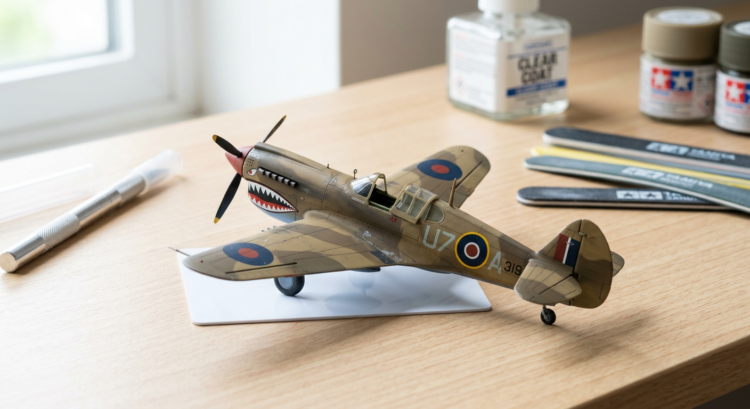

What You’ll Need
Skill level: Beginner to early-intermediate. No airbrush is strictly required — a rattle-can works for the base and clear coats — but an airbrush gives finer control at every stage.
Time commitment: Plan for multiple sessions across three to seven days. Active work runs 30–90 minutes per session; most elapsed time is waiting for primer, paint, and clear coats to cure. A hairdryer on low heat speeds acrylic drying, but never use it on enamels, which need a 24-hour cure before you mask over them.
Tools
- Airbrush (double-action, gravity-feed recommended) with a compressor, pressure regulator, and moisture trap — or a rattle-can/aerosol spray paint
- Paintbrushes: flat sizes No. 0, No. 1, and No. 2, plus a stiff flat brush for dry-brushing
- Fine-tipped tweezers (reverse-action preferred for decals) and a hobby knife with a supply of fresh No. 11 blades to prevent slipping and tearing
- Masking tape: hobby-grade, low-tack (Tamiya is the standard; hardware-store tape has too much tack and lifts paint)
- Sanding sticks and sponges in graduated grits: 400, 600, 800, and 1,000 minimum
- Cotton swabs (Q-tips) for wash cleanup and decal positioning, plus paper towels or cotton pads and small glass or plastic mixing jars
- A painting handle or jig (a dowel taped into the landing-gear bay works; Tamiya’s multi-function paint stand is the commercial option)
Materials
- Primer: hobby-grade acrylic polyurethane primer (Tamiya Surface Primer, Vallejo Surface Primer, Gunze Mr. Surfacer) or an aerosol primer made for plastic
- Base-coat paint: acrylic (Tamiya, Vallejo, Gunze/Mr. Color), enamel (Humbrol, Model Master), or lacquer (Mr. Color Lacquer, Tamiya Lacquer) — match the thinner to the paint type
- Thinners: water or alcohol for acrylics; mineral spirits/odorless enamel thinner for enamels; lacquer thinner for lacquers. Never mix bases
- Gloss clear coat: Tamiya X-22, Vallejo Gloss Varnish, or Pledge Floor Gloss (formerly Future), the classic U.S. budget choice for pre-decal prep
- Matte/flat clear coat: Tamiya Flat Base (XF-86), Vallejo Matte Varnish, or Testors Dullcote; a satin clear is optional for finishes between full gloss and dead flat
- Decal setting solution (Micro Set, blue bottle) and decal softening solution (Micro Sol, red bottle)
- Artist’s oil paints or a pre-mixed enamel panel-line wash (AMMO by Mig, AK Interactive), plus odorless mineral spirits for cleanup
- Weathering pastels or chalk in brown, gray, and black, and a silver Prismacolor pencil for chipping
Prerequisites: This guide assumes the model is assembled, with seams filled, putty sanded smooth, ejector-pin marks on visible surfaces filled, and the cockpit masked or a canopy fitted. Assembly, putty, and seam work are covered in a companion building guide.
The Pro Routine for Finishing Model Airplanes, Step by Step
Work through these 12 steps in order — each prepares the surface the next one needs.
Step 1: Wash and Prep the Surface
Degrease the entire model before any paint touches the plastic. Mold-release agents from manufacturing, plus skin oils picked up during assembly, form an invisible contamination layer that makes paint bead or refuse to adhere — a defect called fish-eye. Scrub the model with mild dishwashing soap and warm water using an old toothbrush, or wipe it down with isopropyl alcohol on a lint-free cloth.
Silicone contamination shows up as a circle or cluster of circles where paint fails to form a solid film. In one documented case, a builder wiped a model with a blue paper towel and alcohol, primed it, and found the cleaning had spread residue into a contaminated patch on the nose. The fix: sand the area lightly with a 600-grit sponge, clean again, and re-prime. Give the whole model a final wipe right before priming, and don’t handle it with bare hands afterward.
TIP: Let the model dry completely after washing before any paint goes on. Thirty minutes of air-drying is the minimum; overnight is better.
COMMON MISTAKE: Wiping down with the wrong cloth. Blue shop paper towels can transfer contaminants — use white paper towels or lint-free cloths.
Step 2: Prime the Model
Prime the model for two equally important reasons: primer gives paint a mechanical surface to bite into, and it reveals every flaw in your assembly — unfilled seams, sanding scratches, sink marks, proud putty edges — while they can still be fixed. Without primer, paint peels off plastic easily. As you spray, aim to get the surface just wet: too dry leaves a grainy finish, too wet runs and sags.
There are three approaches to priming. No primer is acceptable only on well-prepared builds with paint that bonds directly — not for beginners. A neutral undercoat (a thin mid-tone coat) improves color accuracy but does not fill imperfections. A true surfacing primer is the standard professional choice: micro-fillers level minor scratches and reveal flaws before they become permanent.
Primer color matters: black under cockpit interiors auto-generates shadow, white makes lighter colors vibrant, and gray is the neutral default. Advanced builders use colored primers such as red oxide, olive green, or zinc chromate as a first step in pre-shading and chipping.
TIP: Use a 0.4mm or 0.5mm nozzle when airbrushing primer — it is thicker than finish paint and will clog a 0.3mm nozzle. Set air pressure to 22 PSI or above.
COMMON MISTAKE: Laying primer on too heavily in one coat. It sags, runs, and buries fine engraved detail. Apply light coats, let each flash off, then build coverage.
Step 3: Apply the Base Color Coat
Once the primer is cured and corrections are sanded and touched up, spray the base color. The most common mistake here is painting too heavily in a single pass. Use a thin, multi-pass approach: a light tack coat, a medium coverage coat, then a final leveling coat, all with the paint at the right viscosity. Thin it to roughly the consistency of skim milk (about one part paint to 1–1.5 parts thinner for acrylics, though ratios vary by brand), and test on scrap before committing to the model.
Keep the airbrush stroke slow and steady with continuous momentum, and release the trigger as you pull away. Stop with the paint still flowing and each end of the pass builds up into a ball — an effect known as barbelling.
Account for scale effect, too: colors look lighter and less distinct with distance. To compensate, lighten base colors with white — roughly 15% by volume for 1/32 scale, 25% for 1/48, and 30% for 1/72, according to a long-standing scale-effect formula from U.S. modeler Pat Donahue, documented on j-aircraft.com — a widely cited but decades-old benchmark.
TIP: Use a painting jig — a dowel pushed into the exhaust or landing-gear bay — so you can rotate the model while painting without touching wet paint. Tamiya makes a commercial multi-function paint stand.
COMMON MISTAKE: Starting the airbrush stroke on the model. Always begin and end each pass off the surface to avoid blobs and overspray bursts at the edges.
Step 4: Mask and Paint Camouflage or Secondary Colors (If Your Subject Has Them)
If your aircraft wears a multi-color camouflage scheme or secondary color areas, always paint the lightest color first: darker colors cover lighter ones cleanly, but lighter colors won’t fully cover darker ones without several coats.
For a crisp, hard-edge demarcation, press hobby-grade low-tack tape (Tamiya Masking Tape is the industry standard) flush to the surface as a physical barrier. Never use hardware-store masking tape — it has too much tack and lifts the paint beneath it. For the soft, feathered edges seen on most WWII Luftwaffe and RAF aircraft, raise the tape slightly off the surface or hold torn paper strips just above the model so overspray diffuses beneath the edge. Dropping the air pressure (from roughly 18 PSI to 12–14 PSI) narrows the spray pattern and tightens that soft edge; for mottling, a slight increase from about 1.0 bar to 1.3 bar disperses the paint less.
Scale drives the demarcation: in 1/72 and smaller, keep camouflage edges tight (near hard-edge), since a soft edge looks proportionally too wide; in 1/32, a broader, softer edge is more accurate.
TIP: After masking, lay a thin coat of the color already on the model along the tape edge before spraying the new color. This seals the tape and prevents paint from seeping under it.
COMMON MISTAKE: Pulling masking tape too late. Once paint fully cures (48+ hours for enamels), tape can lift it. Remove tape once the paint has dried to the touch but not fully hardened.
Step 5: Apply the Pre-Decal Gloss Coat
Before any decal touches the model, spray a full gloss clear coat over the entire surface — not just the decal zones. A glass-smooth gloss surface is the single most effective defense against silvering, the trapped-air defect that makes decals look encased in film rather than painted on. Coat the whole model, because gloss confined to decal areas leaves visible sheen mismatches — glossy patches in flat paint that read as mistakes.
Tamiya X-22 Gloss, Vallejo Gloss Varnish, Gunze Mr. Super Clear Gloss, and Pledge Floor Gloss (formerly Johnson’s Future) are the most common U.S. choices, Pledge a longstanding budget favorite. Apply in thin coats and let it cure fully — four to six hours minimum, overnight preferred — before decaling.
TIP: Spray gloss at the right pressure (15–18 PSI for an airbrush) with proper thinning. A too-dry gloss coat comes out matte or orange-peeled rather than glossy.
COMMON MISTAKE: Skipping the gloss coat because the base color already looks smooth. Even a semi-matte or satin surface causes silvering — only a true gloss surface prevents it consistently.
Step 6: Apply Decals and Prevent Silvering
Cut each decal from the sheet as close to the printed image as possible, using a sharp No. 11 blade on a self-healing mat — every millimeter of extra carrier film is a potential silvering point. Dip the trimmed decal in room-temperature water for about 10–15 seconds, then rest it on a paper towel for another 10–15 seconds; it should slide freely on its backing without floating off. Don’t oversoak it, or the adhesive dilutes.
Micro Set (blue bottle) is the setting solution. Brush a thin coat onto the receiving surface before placing the decal, then a second thin coat over the positioned decal to aid settlement. Micro Sol (red bottle) is the stronger softening solution, for curved surfaces, panel-line intersections, and rivet-heavy areas where the decal must drape over detail. It fully softens the film, so do not touch, press, or reposition the decal while it works — it will wrinkle and can tear. Let it dry; the wrinkles self-level. Position decals with a damp brush or cotton swab, never bare fingers, since skin oil impairs adhesion.
TIP: On curves and textured areas, let Micro Sol do the work and keep your hands off. If it wrinkles, walk away — it flattens as it dries.
COMMON MISTAKE: Using Micro Sol on a matte or semi-matte surface. The softening solution needs a gloss base to work correctly; on flat paint it leaves residue and won’t prevent silvering.
Step 7: Seal and Flatten the Decals
Once every decal is fully dry — 12 to 24 hours, overnight being safest — apply a second clear coat to lock them down. This seals the decal edges, keeps the film from lifting during later weathering, and unifies the surface so decals and paint become indistinguishable.
Choose the sheen to suit what comes next: gloss if further weathering steps that need a smooth surface lie ahead, satin for subjects with a semi-gloss real-world finish, or straight to matte if no further weathering is planned. (Step 11 covers matching the final sheen to your specific subject.)
COMMON MISTAKE: Sealing the decals too soon, while they are still hydrating. Trapping moisture under a clear coat can leave a milky cloudiness.
Step 8: Apply Panel-Line Washes
A panel-line wash is heavily thinned paint that flows into engraved panel lines, rivet depressions, and recesses by capillary action. It adds the depth and shadow that make a model read as three-dimensional rather than flat.
Mind the paint chemistry: apply enamel or oil-paint washes over an acrylic or lacquer base coat, so you can clean up with odorless enamel thinner without disturbing the color underneath. Never apply an enamel wash over an enamel base — the cleanup thinner dissolves both layers at once. Touch a fine brush loaded with thinned wash to a panel line and let capillary action draw it in, working in sections. After 20–30 minutes of drying (not full cure), wipe excess off flat surfaces with a cotton swab dampened in odorless enamel thinner, stroking across the panel line rather than along it.
Color depends on the base: dark brown or black washes suit light-colored aircraft; for dark subjects such as all-black night fighters, use a light gray wash — the inverse of the rule.
TIP: If wash flows onto a decal, score the decal along the panel line with a fresh No. 11 blade first. That lets the wash flow into the line instead of pooling on the decal film.
COMMON MISTAKE: Washing over a matte surface. The wash flows unevenly and stains permanently. Always wash over a gloss or satin surface so cleanup stays clean.
Step 9: Dry-Brush the Raised Details
Dry-brushing deposits a trace of paint on raised edges, rivet heads, panel edges, and structural ridges, creating highlights that make the model look three-dimensional. Load a stiff, flat-bristle brush with paint slightly lighter than the base color (or silver/aluminum for a metal-chip effect), then drag the bristles across a paper towel until almost nothing comes off. Dragging the brush lightly across the model then “leaves just enough paint on raised edges and ridges to highlight the detail”, leaving the recesses dark. Repeat until the highlight reads naturally at arm’s length.
TIP: Humbrol enamels are excellent for dry-brushing — their slight oil content extends the working time, and they thin predictably with enamel thinner.
COMMON MISTAKE: Over-dry-brushing. A little goes a very long way. Step back and judge at arm’s length; if the highlight reads as painted on rather than natural, it’s too heavy.
Step 10: Add Weathering Effects (Optional Layer)
Weathering is optional, and on a first attempt it should stay restrained. The most controllable chipping method for beginners is a silver Prismacolor pencil sharpened to a needle point: draw tiny marks along wing leading edges, engine access panels, prop tips, and around Dzus fasteners — the high-traffic spots where paint actually chips. Let reference photographs guide placement, not imagination.
A more advanced option is the hairspray method: airbrush hairspray (Aqua Net or a specialty chipping fluid) over the base coat as a barrier, apply the camouflage over it, then reactivate the hairspray with water and a stiff brush to lift the camouflage selectively and reveal the base color — go slowly, as the effect escalates quickly. For staining, brush powdered chalk pastels (black, brown, gray) from the exhaust vents back along the fuselage in the direction of airflow, using a wide flat brush for broad areas and a fine brush for concentrated streaks, then blend with a cotton swab.
TIP: Apply all weathering before the final matte clear coat. The clear coat locks pastels and oil-paint streaks in place so they aren’t wiped off in handling.
COMMON MISTAKE: Over-weathering on a first build. Heavy grime or extreme damage reads as lack of control, not realism. Apply subtly, evaluate at arm’s length, and add more only if needed.
Step 11: Apply the Final Clear Coat and Match the Sheen
The final clear coat seals all weathering, locks in pastels and pencil work, and brings the model to a single unified sheen. Match it to the real aircraft: WWII-through-Cold-War military aircraft are typically matte to satin (Testors Dullcote, Tamiya Flat Base, Vallejo Matte Varnish); natural-metal-finish aircraft and WWII silver trainers are gloss or semi-gloss to mimic polished aluminum; modern civilian airliners run semi-gloss to gloss. A 50/50 mix of satin and matte varnish is a reliable default for a realistic “used” military finish.
Sheen consistency is not optional: glossy patches next to matte areas read as a mistake, so coat the entire model uniformly in a single session.
TIP: Apply matte clear in thin coats. A single heavy wet coat can turn matte varnish chalky or milky, especially in humid conditions. Thin coats build a consistent flat finish without clouding.
COMMON MISTAKE: Spraying flat clear in high humidity. Trapped water vapor blushes the coat white. Work below 60% relative humidity or in a climate-controlled room.
Step 12: Reassemble and Add the Final Small Parts
Save the delicate, easily damaged parts for last: landing-gear legs and doors, propellers, antennas (stretched sprue, metal wire, or EZ Line), the canopy, wing-tip lights, pitot tubes, and ordnance. Painted separately, they now attach over the finished paint job, so glue choice matters.
For the canopy, use a canopy cement — Formula 560 Canopy Glue, Micro Kristal Klear, or Elmer’s white glue. These PVA-based adhesives dry crystal clear and don’t fog or craze clear plastic, whereas superglue (CA) fumes permanently cloud clear parts. For landing gear and metal parts, use cyanoacrylate — thin for small parts, gel for load-bearing joints — since it bonds dissimilar materials like metal to painted plastic that plastic cement cannot. Attach antennas and fragile photo-etch with thin superglue applied by a pin or micro-tip.
TIP: Before removing canopy masking, warm the tape very slightly with a hairdryer on low. The gentle heat softens the adhesive and lowers the risk of pulling paint off the canopy framing.
COMMON MISTAKE: Pulling canopy masking straight across the painted frame. Peel the tape back on itself at a low, roughly 45-degree angle, toward the tape rather than away from the frame, so you don’t lift paint.
Tips and Pro Shortcuts
- Warm your paint. Cold paint thickens and atomizes poorly. Let jars sit at room temperature for 15 minutes before thinning and spraying, and avoid airbrushing in very cold spaces.
- Thin to skim milk. Aim for skim-milk consistency and test on scrap card first. If the paint beads, it’s too thick; if it runs immediately, it’s too thin.
- Clean brushes at once. Rinse brushes in the right thinner immediately after use and never let paint dry in them. For acrylics, a dedicated brush-cleaner solution beats plain water for bristle life.
- Use a clothespin as a handle. A wooden clothespin makes a free, adjustable clamp. Grip a small part, paint, and stand it in a block of foam to dry with no surface contact.
- Never touch wet paint. Keep a dedicated “wet part” station — masking-tape loops on cardboard — so painted parts rest without touching anything. Finger oils on wet paint cause adhesion failures in later coats.
- Test before you commit. Run any new paint or clear coat on scrap plastic first to confirm thinning ratio, pressure, and color before it matters.
- Do the tape test. After priming, press masking tape onto the primed surface and pull it off quickly (not back on itself). If primer lifts, there’s contamination — clean and re-prime before painting.
Troubleshooting and Common Mistakes
Orange-peel texture
Problem: The paint surface has a bumpy, dimpled texture like orange skin.
Cause: Paint drying before it fully atomizes — from paint too thick, pressure too high, the airbrush held too far away, or a too-warm, too-dry room.
Fix: Sand back with 600–1,000-grit wet paper, clean, re-prime if needed, and re-spray properly thinned paint at 6–8 inches and 15–18 PSI. For gloss, start with light tack coats.
Decal silvering despite a gloss coat
Problem: Decals show a milky, silvery edge or haze even after a gloss coat.
Cause: The gloss coat wasn’t smooth enough, or the decal went on before it fully cured.
Fix: Apply several coats of Micro Sol to soften and press the film down. If it persists, prick the area with a pin, apply Micro Sol, press, and re-gloss. Next time, cure the gloss coat overnight before decaling.
Wash won’t lift out of unwanted areas
Problem: Panel-line wash has dried hard on the flat surface and resists a damp swab.
Cause: The wash cured fully before cleanup, so it now needs more aggressive solvent action.
Fix: Work the area with a swab in fresh enamel thinner using short, gentle strokes, without flooding it. Aim to clean wash within 20–30 minutes of applying it.
Flat coat pulls up under masking tape
Problem: The matte clear coat peels or lifts when you remove tape.
Cause: The matte varnish hadn’t fully cured before taping, or it was applied too thickly and stayed soft inside.
Fix: Let a matte coat cure at least 24 hours before taping, and warm the tape with a hairdryer on low before removal. If paint lifts, clean, re-paint, re-clear, and cure fully.
Camouflage build-up showing through thin decals
Problem: Decals over a camouflage boundary show color shift or bleed-through from the darker color.
Cause: The carrier film is too thin, or the underlying color contrast is too strong.
Fix: Brush a thin coat of white or light gray under the decal position before the gloss coat, or mask and paint that area white before decaling.
Wrong wash solvent lifts the finish coat
Problem: Thinner used to clean an enamel wash also dulls or dissolves the enamel base beneath it.
Cause: An enamel wash was applied over an enamel base — both dissolve in the same solvent.
Fix: Prevention only: always apply enamel washes over acrylic or lacquer base coats. If it’s already happened, let the wash dry and leave it, or strip and repaint the area.
Verification and Conclusion
Check your work under raking light — hold the model at a low angle to a strong light source. The sheen should be consistent across every surface; glossy hot spots mean uneven clear coating, and matte patches inside a nominally matte finish point to wash or contamination residue. Decal edges should be invisible at normal viewing distance; if you can see them, the gloss base coat was too thin or the film wasn’t trimmed close enough. Panel lines should read as natural shadow, not drawn ink; if they look scribbled, the wash went on too heavy or wasn’t blended, and a light mist of thinned base color can soften it. Weathering passes the test when a viewer can’t tell whether it’s intentional.
Once this 12-step routine feels comfortable, the natural next steps are pre-shading and post-shading for panel-to-panel variation, then natural metal finish (NMF) painting — one of the most demanding challenges in scale aircraft modeling.
Frequently Asked Questions
How do I stop my decals from silvering on a model airplane?
Prevent silvering by applying decals only over a glass-smooth gloss clear coat, trimming the carrier film close to the image, and using Micro Set and Micro Sol.
- Gloss-coat the entire model and cure it overnight before any decal goes on; after the decals dry (12–24 hours), seal with a second gloss coat.
- Trim the carrier film to within 0.5–1mm of the printed marking.
- Brush Micro Set on the surface, position the decal, then apply Micro Sol over curves and texture — and don’t touch it while it works.
What order should I paint and mask camouflage colors in?
Always paint the lightest color first, then mask, then work to the darkest, because dark colors cover light ones completely while light colors are semi-transparent over dark.
- Paint the lightest color across the whole surface, mask with hobby-grade low-tack tape (flush for hard edges, raised for soft), then apply the medium color and the darkest last.
- For soft edges, hold a torn paper strip just above the surface instead of pressing tape flat.
Do I need to prime a plastic model airplane before painting it?
Yes — priming is strongly recommended for beginners and necessary for professional results. It improves adhesion, reveals surface flaws before the base color hides them, and gives a consistent color base.
- Bare paint peels at handling points, and primer reveals unfilled seams, scratches, and sink marks while they can still be fixed.
- Choose color strategically (black for cockpits, white for light finishes, gray as neutral) and apply thin coats at 22 PSI or above through a 0.4–0.5mm nozzle.
What’s the difference between a panel-line wash and weathering?
A panel-line wash is one targeted technique that adds shadow depth to engraved lines with thinned paint, while weathering is the broader category of techniques that simulate use, environment, and age.
- Panel-line wash: thinned enamel or oil paint drawn into engraved lines by capillary action, then cleaned off raised surfaces. The goal is shadow, not dirt.
- Weathering also includes dry-brushing, chipping, pastel staining, filtering, and streaking; the wash comes first, pastels and chipping last, before the final matte coat.
Why does my clear coat look shinier in some spots than others?
Uneven sheen comes from inconsistent clear-coat application — too dry in some areas, too wet in others — or from coating a surface that wasn’t uniformly prepared, such as a matte wash left without a gloss coat.
- Common causes: interrupted passes, varying distance, cold/warm surface variation, or matte varnish over a partly absorbed coat.
- Fix with steady, overlapping passes at consistent speed, distance (6–8 inches), and pressure in one session; for serious mismatch, cure fully, level with 2,000-grit wet paper, and re-clear.

Key Takeaways
- Sequence is everything. Each finishing step depends on the one before it — surface prep before primer, primer before paint, gloss before decals, matte or satin last.
- Gloss before decals, matte/satin last. A glass-smooth surface prevents silvering, and the final flat coat creates a realistic, unified finish.
- Let drying time run the schedule, not impatience. Rushing a single coat is the fastest way to ruin a build.
- Go light on weathering your first time. Build confidence before adding complexity.
- Always test paint, thinning, and clear coat on scrap plastic before it reaches the model.