


The paint step doesn’t have to be terrifying. Here’s the exact sequence pros use to get a smooth, professional finish on your very first model airplane.
You glued the last part into place, set the model on the bench, and stepped back — and the real challenge showed up. It isn’t the gluing; it’s the painting. Plenty of first-time builders study references through the whole build, then feel unmoored the first time they open a bottle of Tamiya XF-series paint.
This guide to painting model airplane kits takes you from bare plastic to a smooth, even, sealed finish using either spray cans or a basic airbrush. We’ll walk every stage — surface prep, primer, color, curing, masking, and clear coat — through to the point where the model is ready for decals. Here’s why it matters more than any other step: paint is what separates a display-worthy aircraft from a hobby-store shelf piece. A rough coat makes even a flawless build look amateurish, while a smooth, correctly colored one flatters an imperfect build.
We write from the collective experience of modelers with years at the bench across Tamiya, Mr. Color, Gunze, Vallejo, and AMMO paints, in scales from 1/144 to 1/32. This guide assumes no prior painting or airbrush experience and treats brush-painting as a legitimate fallback for detail work. With a finished or nearly finished kit in hand, you’re ready.
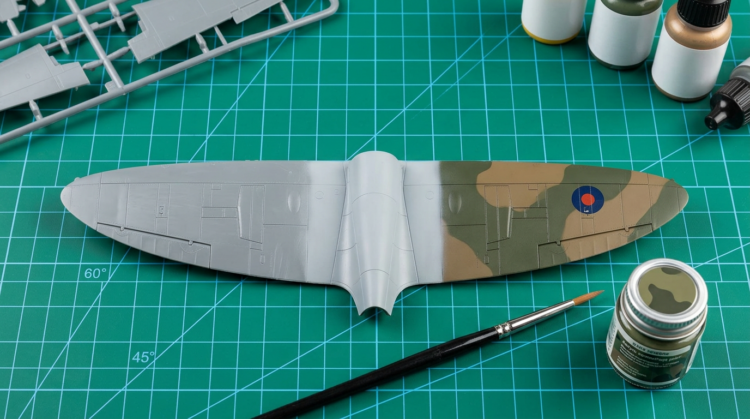 What You’ll Need Before You Start
Skill Level and Time
- Skill level: None required — no painting experience assumed.
- Hands-on time: Roughly 3 to 5 hours of active work across a weekend, with drying and curing in between. A single-color subject — a black night fighter or an overall-silver aircraft — can be finished across two days; multi-color schemes add masking time.
- Reality check: Patience is the most important skill here. Most beginner mistakes come from rushing between coats.
Choose One Paint Family
Pick one paint family and stick with it for your first build — mixing families adds thinner-compatibility headaches you don’t need yet.
| Paint Type | Chemistry | Thinner | Dry Time (recoat) | Beginner Rating |
| Acrylics (Tamiya, Vallejo, Mr. Hobby Aqueous) | Water/alcohol-based | Water or acrylic thinner | 20–30 min (thin coats) | ★★★★★ Best for beginners |
| Enamels (Humbrol, Testors) | Oil-based | Mineral spirits / odorless thinner | 1–2 hrs touch dry; 24 hrs for masking | ★★★☆☆ Intermediate |
| Lacquers (Mr. Color, Tamiya lacquer, Alclad) | Solvent-based | Lacquer thinner | 15–30 min dry; 24 hrs cure | ★★☆☆☆ Needs ventilation, experience |
For a first build, reach for Tamiya acrylics (X-series gloss, XF-series flat) or Mr. Hobby Aqueous (H-series) — forgiving, widely stocked at U.S. hobby shops, and easy to clean up. One brand note: Tamiya’s acrylics are alcohol-based, so thin them with Tamiya’s X-20A or with Mr. Color Leveling Thinner (MLT) for airbrushing — not plain water, which can cause adhesion problems. Vallejo paints are true water-based acrylics and thin with water or Vallejo’s own thinner.
Essential Tools and Supplies
- Painting supplies: primer (gray, white, or black — guidance in Step 2); your main color paints; clear coat (gloss for pre-decal work, flat or matte for the final finish); and the correct thinner for your paint, always the manufacturer’s recommended one.
- Application equipment: quality spray cans OR a basic double-action airbrush with a compressor (full comparison in Step 3), plus fine-detail brushes in at least two sizes — a No. 2 for medium areas and a No. 0 for small details, in sable or high-quality synthetic.
- Masking supplies: Tamiya masking tape (thinner and more conformable than hardware-store tape), sharp No. 11 hobby knife blades and a cutting mat, and cotton swabs and toothpicks for decal work.
- Workspace and safety: nitrile or latex gloves; a respirator or half-mask with the right cartridges for solvent-based paints (a paper dust mask at minimum for acrylics); a well-ventilated area or spray booth — at minimum a large cardboard box with the front cut away, near an open window or stove vent; paper towels and lint-free cloths; isopropyl alcohol (IPA); and a tack cloth for final dust removal.
Set Up a Safe Workspace
⚠️ SAFETY FIRST
|
Step 1: Prep the Surface Before Any Paint Touches It
Every plastic kit leaves the factory coated in mold-release agents — invisible lubricants that help the plastic pop free of the mold, and that actively repel paint. Every time you handle the kit, your skin also transfers oils onto the plastic. Both have to go before primer.
Clean every surface you plan to paint:
- Wipe all plastic surfaces you plan to paint with isopropyl alcohol on a lint-free cloth, working nose to tail in one direction so you don’t re-spread contamination.
- Or wash the model under lukewarm water with a little dish soap, using an old soft toothbrush for panel lines and recesses. Rinse thoroughly and air-dry completely — an incomplete dry causes adhesion problems and fish-eye.
- Don’t reach for a blue paper towel with alcohol. Some carry an unknown contaminant that can cause fish-eye in primer. Use white kitchen paper or a lint-free cloth.
Do a Final Seam and Panel-Line Check
With the surface clean, examine it under a raking light — a lamp held at a low angle to the surface. This is your last chance to catch:
- Seam lines from joined fuselage or wing halves
- Sink marks — shallow depressions over thick sections of plastic
- Ejector-pin marks on visible surfaces
- Scratches left over from earlier sanding
Anything visible now will be amplified by paint, not hidden. Fix remaining flaws with an appropriate putty — Tamiya Basic Putty, Squadron Green Putty, or Perfect Plastic Putty — then sand flush and re-inspect.
| TIP — KILL THE DUST
Right before the first coat of primer, wipe the model with a tack cloth — a slightly tacky decorating cloth from hardware stores — to lift any last dust. It leaves a residue, so wash your hands before touching the model again. You can also blow high-pressure air from the airbrush over the model to knock loose stray particles. |
Step 2: Apply Primer — And Why Skipping It Is the #1 Beginner Mistake
Primer does two jobs no other step can replicate:
- It creates an adhesion base. Bare polystyrene is slightly waxy and chemically inert, so finish paints can adhere poorly and peel — especially where you hold the model. Primer keys into the plastic and gives every color coat a mechanical grip.
- It detects flaws. A uniform coat of gray, white, or black primer reveals every imperfection under raking light: hidden seam lines, shallow sink marks, putty patches that need more work. Catching these now costs 15 minutes; catching them after the final color coat costs hours.
How to Apply Primer
Equipment note: Primers are more viscous than finish paints — many contain micro-fillers — so if you airbrush them, use a 0.4mm or 0.5mm nozzle and raise the pressure to about 20–22 PSI. Aerosol primers from model brands (Tamiya, Mr. Surfacer) beat automotive aerosols, which lay down too heavily and bury fine detail.
- Lay down the first coat as a light dusting coat — don’t try for full coverage. This thin pass gives the next coat something to grip.
- Let it flash off — about 10 minutes for most primer. If a water-based primer beads up, don’t panic: force-dry it with a hair dryer on low, then keep building with light coats.
- Inspect under raking light. Spot-fill, sand, and spot-prime any newly revealed flaws.
- Apply a second light coat for full, even coverage. Aim for a finish that looks “just wet” — uniformly dampened, with no pooling, runs, or sagging.
Pick the Right Primer Color
| Primer Color | Best For |
| Gray | Most applications; a neutral base that won’t bias your colors; best under mid-tone camouflage |
| White | Bright or light colors (yellow, red, light gray); a clean underlayer for weak pigments |
| Black | Deep recesses, cockpits, and engine bays; creates automatic shadow and sets up pre-shading |
A note on weak pigments: yellows and reds can’t cover over a dark base. If you’re laying down a yellow or red topcoat, prime in white first to avoid an endless battle with coverage.
| ⚠️ WARNING — NEVER SKIP PRIMER
Skipping primer “to save time” is the single most common beginner mistake. It costs almost nothing compared with the alternative — a topcoat that won’t stick, chips easily, or hides uncorrected flaws. Primer is the cheapest insurance in the whole process. |
Step 3: Choose Your Method — Spray Cans vs. Airbrush
Both routes can produce an excellent finish; the right one depends on what you’re painting and how much you want to invest upfront. Here’s an honest comparison:
| Factor | Quality Spray Cans | Basic Airbrush + Compressor |
| Cost of entry | Low (per can; adds up over time) | Higher upfront; lower per project long-term |
| Color range | Limited to the manufacturer’s can range | Unlimited — mix any bottled paint |
| Control | Moderate; fixed nozzle, limited pressure | High; adjustable pressure, needle, distance |
| Learning curve | Minimal; technique-focused | Steeper; needs practice and maintenance |
| Finish ceiling | Good; excellent for single-color builds | Excellent; enables advanced techniques |
| Portability | Very portable | Requires a compressor setup |
| Clean-up | None (invert, clear, done) | Thorough cleaning after each session |
| Thin coats | Achievable with technique | Precise control |
For a first monochromatic build, start with spray cans. They’re the lower-barrier option, and Tamiya’s lacquer-based cans lay down a consistent, high-quality finish with the right technique. Move to an airbrush the moment you want multi-color camouflage, pre-shading, post-shading, or weathering with thin-mixed paints.
Spray-Can Technique Notes
- Shake the can vigorously for a full minute. If you can’t hear the agitator ball rattling, don’t use it.
- Warm the can first: stand it in a pan of hot tap water (not boiling) for a few minutes — warm paint flows and atomizes better.
- Start spraying off the model, sweep across in smooth passes, and finish off the model. Starting or stopping on the model causes blobs and splatters.
- Hold the can roughly 10 to 12 inches (25–30 cm) from the surface.
- Aim for three passes — a dusting coat, a color coat, and a leveling coat — letting each flash off in between.
Step 4: Mix and Thin Your Paint (If Airbrushing)
The industry-standard starting ratio for airbrushing is 25% to 33% thinner by volume — 3:1 or 4:1 paint-to-thinner. Treat it as a starting point, not a rule.
A more reliable test is the “consistency of milk” benchmark: swirl the jar and look at the film on the glass. If it matches the thin film whole milk leaves, the mix is ready.
One caveat: forums often suggest 50/50 ratios, but those are frequently too thin, and over-thinning cuts coverage and pigment density. Start at 25–30% thinner, test on a scrap panel or an old wing, and add more in small increments only if needed.
Match the Thinner to the Paint
The wrong thinner makes paint fish-eye, separate, or fail to stick:
| Paint Type | Recommended Thinner |
| Tamiya acrylics (X/XF series) | Tamiya X-20A, or Mr. Color Leveling Thinner (MLT) for superior flow |
| Vallejo acrylics | Vallejo Airbrush Thinner or distilled water |
| Mr. Color / Gunze lacquers | Mr. Color Leveling Thinner or Mr. Thinner |
| Humbrol / Testors enamels | Mineral spirits (odorless preferred); enamel thinner |
| Tamiya lacquer spray cans | Pre-thinned; no user thinning needed. (Uses lacquer thinner chemistry — different from their acrylic line) |
The key rule: always use the manufacturer’s recommended thinner; don’t substitute a random lacquer thinner for an acrylic thinner.
Can you thin Tamiya acrylic with Mr. Color Leveling Thinner? Yes — it’s one of the most widely used combinations in the hobby, giving Tamiya acrylics a smoother, more self-leveling spray. For brush painting, though, MLT speeds drying and can leave brush marks, so use it carefully or add a retarder.
Mixing, Step by Step
- Remove the metal agitator ball with tweezers, and pour the paint into a clean glass jar or airbrush bottle.
- Add a few drops of thinner to the empty paint bottle, shake, and pour the remaining pigment into the jar.
- Fill a second identical jar to 25–33% of the paint’s height with thinner, using the paint height as your gauge.
- Pour the thinner into the paint jar and shake well.
- Test-spray on scrap plastic or card, adding thinner in small increments if needed.
| TIP — LABEL YOUR MIX
Label and date every jar with the manufacturer, color, and mix date. Stored mixed paint can be reused for touch-ups, but thinned paint has a short shelf life — when in doubt, remix. Never leave primer in the airbrush between sessions; it will solidify and clog the nozzle. |
Step 5: Apply the Base/Color Coat
Spray-Can Technique
Spray-can work is about restraint: trying to cover the model in one or two passes is the most common cause of runs, sags, and orange peel. Shake for a full minute and warm the can in hot tap water (not boiling) as described above, hold it 10 to 12 inches away, and sweep in steady, continuous passes — never slowing or lingering. Then work the three-pass method:
- Pass 1 — dusting coat. It won’t fully cover; it gives the next coats something to grip. The plastic should look misted but still show through.
- Pass 2 — color coat. Full color emerges. The surface looks uniformly colored but may still be slightly uneven.
- Pass 3 — leveling coat. This evens out the finish and produces the smooth surface. Don’t apply it too heavily — this is where runs happen.
After use, invert the can and press the nozzle to let the propellant clear the tip so it doesn’t clog.
Airbrush Technique
Set your pressure:
- General work — flat surfaces and broad coverage: 15–20 PSI.
- Corners, recesses, and fine or raised detail: drop to 10–15 PSI to keep overspray from causing orange peel.
Distance: hold the airbrush about 4 to 8 inches (10–15 cm) from the surface. Too far gives orange peel — paint dries before it lands; too close gives runs and flooding.
Trigger technique (double-action airbrush): start the air first, then pull back for paint. Never release paint before air — paint in the nozzle without airflow causes spitting.
Your first coat should look transparent — that’s correct. Don’t add more over a wet coat: let it flash off, then lay the second to the same depth. On the third you can lay slightly more, but stop well before the surface looks glossy or wet.
Use a cross-coat for even coverage: apply the first coat left to right; once it flashes off, apply the second top to bottom, so no stripes or light gaps show between passes.
Get the Painting Order Right
- Paint the underside and wheel wells first. Gravity pulls overspray from topside painting down onto a finished underside, so bottom-first protects it.
- Light colors first, dark colors after. Laying dark over light is far easier than covering dark with light. Weak pigments like yellow and red still need a white undercoat for proper density.
WHAT TO LOOK FOR — “CORRECT” VS. “TOO WET”
|
Step 6: Let It Cure Properly — Don’t Rush This Step
“Dry” and “cured” aren’t the same. “Dry to touch” means the surface won’t smear under a careful touch; “cured,” or “hard dry,” means the paint has reached full strength and can be handled, masked, or sanded. The number that matters most is the time before masking — premature masking is the most common cause of lifting.
| Paint Type | Touch Dry | Recoat Safe | Safe to Mask Over |
| Acrylics (airbrushed, thin coats) | 20–30 min | 30 min | Overnight recommended; minimum 3–5 hrs |
| Enamels (oil-based) | 1–2 hrs | 24 hrs | 3–5 days minimum |
| Lacquers | 15–30 min | 30–60 min | Overnight minimum |
| Different paint types over each other | — | — | Never mask enamel over acrylic (or vice versa) until the undercoat has cured a full week |
The “if it smells like paint, it’s still wet” rule: any lingering odor means the coat hasn’t fully cured — especially enamels, which can smell for days.
On hair dryers: for acrylics, low heat safely speeds drying. It doesn’t work reliably on enamels or lacquers, and should never get close enough to warp the plastic.
Why patience pays off: an uncured coat is still chemically active, so masking over it can pull the underlying paint off cleanly — especially if the tape was pressed firmly for a sharp edge.
Step 7: Mask for Multi-Color Schemes (If Applicable)
You only need this step if your model has two or more colors with defined edges. For a first build, a single-color subject — overall black, overall silver, or a natural metal finish — lets you skip masking and focus on technique.
Follow the light-colors-first rule: paint the lighter color first, cure it fully, mask it, then paint the darker color over the top. Covering light with dark is far easier than the reverse.
Cut and Apply the Tape
- Use Tamiya masking tape — thinner, more conformable, and cleaner to release than hardware-store tape.
- Cut it with a sharp, fresh No. 11 blade. A dull blade compresses the tape edge and lets paint bleed under the mask.
- For curved demarcation lines, pre-draw the pattern on card stock, cut it out, transfer the shape to tape, and cut to match — letting you duplicate the shape and waste less tape.
- Burnish the tape edge firmly with a fingernail or the back of a knife handle to seal it against the surface. Any gap means paint bleed.
- For irregular shapes, use Parafilm M — a laboratory sealing film that stretches and conforms to curves.
Remove the Tape Safely
- Pull the tape off at 45° to 90° to the surface — not parallel to it, which puts maximum stress on the paint underneath.
- Work slowly. Fast removal can lift or crack the paint edge.
- On clear parts, lift the tape edge with a No. 11 blade tip, then pull it away with tweezers. Never force a knife under tape on a painted surface.
| TIP — MASK CLEAR PARTS FIRST
Before any primer or paint touches the model, mask the cockpit transparencies: apply Tamiya tape to the interior, then fill the opening with overlapping strips. This keeps spray off the clear plastic. |
Step 8: Apply a Clear Coat (Gloss or Flat) Before Decals
Laying a gloss coat over the painted model before decals isn’t optional — it’s your defense against silvering, the most common and most stubborn decal problem.
What causes silvering: flat and matte finishes are microscopically rough. When a waterslide decal sits over that texture, tiny air pockets get trapped between its clear carrier film and the paint’s peaks and valleys. Light hitting those pockets scatters, creating the whitish, silvery look around the decal’s edges. A gloss coat fills those valleys and gives the decal a smooth surface to lie flat against, eliminating the air pockets.
The gloss coat process:
- Apply one to two light coats of clear gloss over the entire model — not just where decals go. Partial application leaves visible boundaries where the gloss-to-flat interface shows in certain light.
- Let the gloss coat cure fully — overnight at minimum.
- Apply the decals.
- Once the decals are fully cured, add weathering if you want it.
- Apply a final clear coat in your chosen finish — gloss, satin, or flat. A flat final coat also seals in the decals and evens out the overall look.
Products U.S. modelers reach for: Pledge Floor Gloss (formerly Future Floor Polish) became legendary as an inexpensive, high-quality gloss coat. Tamiya Gloss Clear (spray can), Mr. Super Clear (Gunze), AMMO by Mig Jimenez clear varnishes, and Testors Glosscote are all solid choices.
A chemistry note: clear gloss over acrylics is fine, and an enamel wash can go over a cured gloss coat — enamel over acrylic is safe once the acrylic has fully cured. That sealed coat later protects paint and decals through weathering — washes, oil rendering, and pastels all go over it and wipe back without disturbing the paint beneath, a subject for a future guide.
Troubleshooting and Common Mistakes
Orange Peel Texture
What it looks like: a bumpy, granular surface that resembles orange skin.
Causes: the airbrush held too far away (paint dries before it lands), the wrong or a bad thinner, old paint thickened by evaporation, high humidity above 55–60%, air pressure too high, or paint too thick from under-thinning.
Prevention: use fresh paint, keep humidity below 55%, use the manufacturer’s thinner, set pressure to 15–20 PSI (10–15 near corners), and hold the airbrush 10–15 cm from the surface.
Fix: for lacquers, immediately mist on fresh thinner to re-level (this won’t work on enamels or polyurethane clears). Otherwise let the coat harden 8 to 24 hours, wet-sand with 2000–4000 grit, and respray. If you sand through to plastic, spot-prime and respray.
Runs and Sags
Cause: too much paint too fast — the film can’t support its own weight before it cures.
Prevention: multiple thin coats; never try for full coverage in one session.
Fix: let the run cure completely — never wipe a wet run, which only spreads it. Once cured, carefully sand it flat (start at 800 grit, step up to 1500–2000), then respray the area.
Dust and Lint in the Finish
Cause: airborne particles settling on wet paint — even clean rooms have dust, and the model collects it.
Prevention: minimize air movement while spraying, use a spray booth, and wipe the model with a tack cloth right before painting.
Fix: once fully cured, use 1000-grit wet-and-dry sandpaper (used wet) to gently sand down the particle. If you cut through to bare plastic, spot-prime and respray.
Tip-Dry and Spitting from the Airbrush
What it is: paint drying on the needle tip, so the airbrush spits globs instead of a fine mist — more common with fast-drying acrylics.
Cause: paint building up on the tip during long sessions, under-thinned paint, or too long a delay between trigger releases.
Mid-session fix: touch a cotton swab dipped in the appropriate thinner to the needle tip to dissolve the buildup, then resume.
Prevention: on a double-action airbrush, keep a steady air stream going — air on, paint on; air on, paint off — never cut air and paint at the same time.
Visible Seams Under Primer
Cause: seams or imperfections that weren’t fully addressed before priming.
What to do: don’t move on to color — you can’t fix this under it. Fill the seam with putty, sand smooth, spot-prime, and re-inspect under raking light; repeat until the primer is uniform.
Decal Silvering After Application
If silvering shows up after the decals are on, don’t panic — it can often be corrected:
- Apply Micro Sol (the stronger “setting” solution) generously over the affected decal; let it dry without touching.
- Repeat 3 to 4 times; each application softens the film further, pulling it down against the surface.
- If severe, apply a strong softener (Mr. Mark Softer or Solvaset) and gently work out the bubbles with a cotton swab.
- For extreme silvering, pierce the decal with a pin to release trapped air before applying softener.
Better yet, prevent it: apply decals over a gloss coat in the first place.
How to Verify You Did It Right
A finished paint job should clear every one of these checks:
- Even sheen across all panels. No area looks noticeably shinier or more matte than the rest, before the final clear coat unifies the finish.
- No primer or bare plastic showing through. Under bright light, from several angles, no thin spots show the plastic color.
- No brush marks, orange peel, or texture. A fingertip run across the surface feels smooth.
- No runs or sags. Check panel edges and curved surfaces where paint can pool.
- Fully cured before handling. The paint isn’t even slightly tacky and there’s no residual smell.
- Clean masking lines, if multi-color. No bleed under tape edges; sharp demarcation.
Minor imperfections — a small dust particle, a rough patch — are normal on a first build. Address them with careful wet-sanding and a touch-up coat, and treat them as a learning point. No modeler produces a perfect first effort; consistency comes with practice.
Frequently Asked Questions
What’s the exact order of steps for painting a plastic model airplane kit from start to finish?
The correct sequence for painting a model airplane kit is: surface cleaning → primer → inspect and fix flaws → color coat(s) → curing time → masking (if multi-color) → final color coats → cure → gloss clear coat → decals → weathering (optional) → final flat/matte clear coat.
In order:
- Wipe the plastic with isopropyl alcohol (or wash with dish soap and water) and dry completely.
- Apply primer in two light coats; let it cure.
- Inspect under raking light; fix and spot-prime any revealed flaws.
- Apply the base color in 2–3 thin coats, letting each flash off, then cure overnight before masking.
- If multi-color, mask and apply additional colors in thin coats, then remove the masking and cure.
- Apply a clear gloss coat over the entire model; cure.
- Apply waterslide decals, then weathering (optional).
- Apply the final clear coat in your chosen sheen — gloss, satin, or matte.
Do I need an airbrush to get a good paint job, or can I use spray cans?
Quality spray cans will give a first-time builder a perfectly good paint job without an airbrush, especially on a single-color or simple two-color build.
- Use dedicated model spray cans (Tamiya, Gunze Mr. Color), formulated for scale model plastic.
- Shake for a full minute, and warm the can in hot tap water for a better spray.
- Apply three passes: a dusting coat, a full color coat, and a leveling coat, each started and ended off the model.
- Move up to an airbrush once you want multi-color camouflage, pre-shading, post-shading, or soft-edged demarcations.
Why does my model airplane paint look bumpy or textured instead of smooth?
Orange peel on a model airplane finish is caused by paint drying before it reaches the surface — usually from holding the airbrush or spray can too far away, using old or incorrectly thinned paint, or painting in conditions that are too hot or humid.
To prevent it: hold the airbrush 10–15 cm from the surface (a spray can about 10–12 inches); use fresh paint thinned to the consistency of milk with the manufacturer’s recommended thinner; keep humidity below 55% and temperature between 65°F and 85°F; and set airbrush pressure to 15–20 PSI (10–15 near corners).
To fix existing orange peel: let the coat harden fully (8–24 hours), wet-sand the area with 2000–4000 grit used with water, clean it, and respray with a properly thinned coat. If sanding cuts through to plastic, spot-prime before respraying.
How long should I wait between coats before I can recoat or apply masking tape?
Recoat time depends on the paint type: acrylics can be recoated in 20–30 minutes, but you should wait at least 3–5 hours (overnight preferred) before masking over acrylics, and longer for enamels and lacquers — see the table below.
- Acrylics: touch dry in 20–30 min; recoat in 30 min; mask over after 3–5 hours minimum (overnight preferred).
- Enamels: touch dry in 1–2 hours; recoat after 24 hours; mask over after 3–5 days minimum.
- Lacquers: touch dry in 15–30 min; mask over after 24 hours.
- Universal rule: “if it smells like paint, it’s still wet.” Any remaining odor means curing isn’t complete — don’t mask or handle.
- Across paint chemistries: wait a full week before applying a new paint type over a different one (for example, an enamel wash over an acrylic base).
Can I mix Tamiya acrylic paint with lacquer thinner or Mr. Color Leveling Thinner?
Yes — Tamiya’s X-series and XF-series acrylics can be safely thinned with Mr. Color Leveling Thinner (MLT) for airbrushing, widely considered one of the best pairings in the hobby for smooth, self-leveling spray.
- Tamiya acrylics are alcohol-based, not true water-based, which makes them compatible with mild lacquer-type solvents like MLT.
- Airbrushing: use MLT at the standard 25–33% ratio for a smoother, more self-leveling spray than X-20A alone.
- Brush painting: MLT makes Tamiya acrylics dry faster, which can leave visible brush marks — use it carefully, or add a retarder.
- Don’t use strong hardware-store lacquer thinner with Tamiya acrylics — it can “shock” the paint and make it separate.
- Always test a new thinner combination on scrap plastic first.

Key Takeaways
- Prep is everything. Clean the plastic, check for seams, and prime before any color goes on.
- Thin coats, always. Multiple light coats beat one heavy coat — every single time.
- Primer reveals and protects. It shows flaws before they’re buried and anchors every coat above it.
- Patience on dry time. Masking or handling paint that hasn’t cured fully destroys the finish.
- Gloss before decals. A gloss clear coat prevents silvering, the most common decal disaster.
- Troubleshooting is normal. Orange peel, runs, and dust are fixable problems, not failures.