



Tamiya’s Tomcat still leads 1/32 scale for shape accuracy and structural engineering — but archaic raised panel lines, a cockpit demanding aftermarket, and a premium price mean this kit earns its reputation the hard way.
Brief Overview
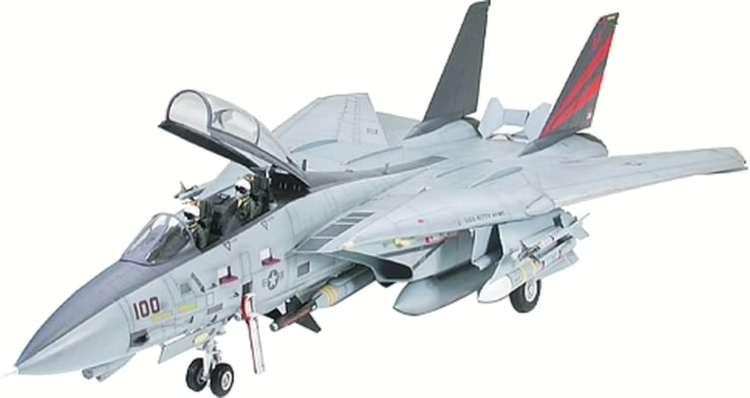
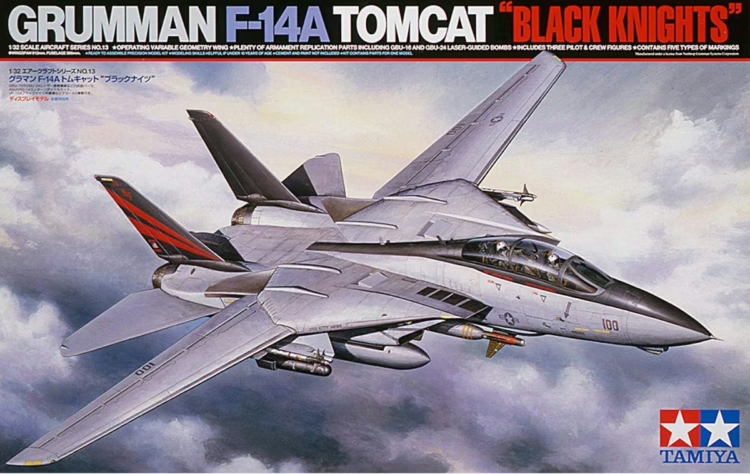
The Tamiya 1/32 F-14A Tomcat “Black Knights” (TAM60313) is the most recognizable large-scale plastic model of what many consider the defining American naval fighter of the Cold War. Completed, it stretches 598 millimeters (approximately 23.5 inches) in length and spans 612 millimeters (approximately 24 inches) tip-to-tip with the variable-geometry wings fully extended — dimensions that dominate a room.
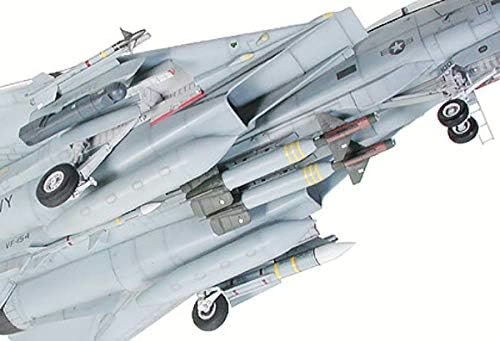
This boxing depicts the F-14A in its late-career “Bombcat” configuration, the result of the aircraft’s 1990s integration of the AN/AAQ-14 LANTIRN targeting pod, which transformed a pure fleet interceptor into a precision ground-attack platform. It captures VF-154 “Black Knights” markings — Carrier Air Wing Five, USS Kitty Hawk, forward-deployed to Yokosuka, Japan. Among the best model airplane kits at 1/32 scale, TAM60313 occupies a singular position: no rival tooling matches its nose geometry, and no other kit delivers the Bombcat loadout with equivalent structural engineering.
The tooling has evolved in three stages: the 1980 original, a 1994 retooling (TAM60303) that added the under-nose Television Camera Set (TCS), NACA-scoop gun vents, ECM blisters, updated TF30 exhaust nozzles, and Mk.82 Snakeye iron bombs, and the 2003 boxing that added LANTIRN pod, GBU-16 and GBU-24 munitions, and updated AIM-9L/M Sidewinders. That history is simultaneously this kit’s greatest asset and its defining limitation.
Who Is This For? A builder with several multi-part aircraft kits completed, a proper scribing toolkit, and the budget for near-mandatory aftermarket upgrades will find this deeply rewarding. Advanced Modeler Syndrome (AMS) is a genuine hazard — cockpit deficiencies alone can spiral build costs considerably. Beginners should enter with clear expectations.
Three Standout Features: The synchronized variable-sweep mechanism — machine screws, metal pivot brackets, and interlocking toothed plastic gears concealed in the fuselage carry-through box — enables reliable actuation for decades. The 2003 ordnance additions deliver a complete Bombcat strike payload: LANTIRN pod, GBU-16 and GBU-24, AIM-54 Phoenix missiles, and updated Sidewinders. The decal sheet covers five aircraft, headlined by the VF-154 CAG bird with its bold red and black tail stripes.
Check current availability and pricing of the Tamiya 1/32 F-14A Tomcat “Black Knights” on Amazon.
Pros & Cons
Pros
- Unmatched scale presence. The completed model’s accurate silhouette and correct nose geometry dominate any display shelf — the most faithful radome and forward fuselage profile in 1/32 scale.
- Robust structural engineering. Solid die-cast metal landing gear inserts, heavy-duty machine screws, and functional swing-wing pivot gears prevent the massive wings from sagging or deforming over decades.
- Comprehensive Bombcat ordnance. LANTIRN pod, GBU-16 and GBU-24 laser-guided bombs, AIM-54 Phoenix missiles, and updated AIM-9L/M Sidewinders definitively capture the F-14A’s late-career precision strike identity.
- Geometrically superior to large-scale rivals. The Trumpeter 1/32 suffers critically incorrect intake angles; the Revell kit has a flat canopy and misshapen radome. The Tamiya avoids both.
Cons
- Antiquated surface detail. The rear fuselage, wings, and stabilizers carry 1980s-era raised panel lines throughout, demanding complete re-scribing to meet any contemporary standard.
- Unacceptable out-of-the-box cockpit. Flat instrument panels relying on waterslide decals force meaningful aftermarket investment — resin or photo-etched — before this build qualifies as serious.
- No high-lift device options. Leading-edge slats and trailing-edge flaps are molded solid; dynamic carrier-launch displays require invasive scratch-building.
- Demanding seam work at critical locations. A prominent seam runs down the clear canopy centerline; a second runs down the internal throat of each engine intake — both in positions that are extremely difficult to clean up.
- No exhaust nozzle options. The TF30 nozzles are provided solely in the fully open afterburner-extended position; historically accurate closed or asymmetric parking configurations require aftermarket resin replacements.
Kit Contents & Engineering
Opening the TAM60313 immediately signals the scale of the project. Several large light gray polystyrene sprues, a dedicated clear sprue for the tandem canopy, a hardware bag containing heavy-duty machine screws and turned metal parts, authentic black rubber tires, and a vibrantly printed waterslide decal sheet fill the box. Three well-sculpted crew figures are included — a seated pilot, a seated Radar Intercept Officer (RIO), and a crouching catapult launch officer (“shooter”) — all fitting the stock plastic seats without modification.
The molding quality splits cleanly along tooling generations. The forward fuselage, radome, and all 2003-era ordnance feature crisp recessed panel lines that would not embarrass a contemporary short-run release. The LANTIRN pod and GBU munitions are molded with twenty-first-century precision. The rear fuselage, main wings, and horizontal stabilizers, however, carry the raised panel lines of the 1980 original — the defining technical obstacle of the entire build. The clear canopy is optically excellent but carries a prominent mold seam along its centerline demanding careful wet-sanding and progressive polishing.
The variable-sweep wing mechanism is where Tamiya’s engineering most decisively justifies the price tier. Metal pivot brackets interlock with toothed plastic gears concealed in the fuselage carry-through box; secured with the provided machine screws, the resulting assembly has the mechanical confidence to survive decades of handling. Both wings sweep simultaneously and symmetrically. The significant caveat: the wings are engineered exclusively in the clean aerodynamic configuration — flaps and slats are molded integrally solid. The engine intake trunks, molded in longitudinal halves, produce a visible seam running down each intake throat upon assembly, requiring difficult sanding in an extremely confined space. At the tail, the TF30 exhaust nozzles are provided solely in the fully open, afterburner-extended position, limiting authentic parking configurations without aftermarket resin replacements.
Where the Tamiya 1/32 F-14A Tomcat “Black Knights” Really Shines
Despite the surface prep demands and the cockpit compromise, there are build moments when the Tamiya F-14A delivers a satisfaction that newer, more technically polished kits simply cannot replicate.
The Build Reward
The first arrives when the wing-sweep hardware goes together. Dropping the die-cast metal pivot brackets into position, aligning the gear teeth, and running the machine screws home produces a mechanical solidity that plastic-only kits cannot match. Sweeping both wings rearward and feeling the synchronizing gears engage evenly is genuinely gratifying — the kind of engineering you trust a finished model with for forty years. The forward fuselage is another high point: the cockpit opening is large enough at this scale to make tandem tub installation manageable, and the broad canopy, polished clean of its seam, settles over the cockpit with a scale accuracy that reference photographs confirm immediately.
The “Black Knights” Livery
The VF-154 decal sheet is the emotional heart of this boxing. Four distinct Black Knights aircraft are covered — tail numbers NF 100, NF 101, NF 105, and NF 111 — plus markings for the VF-14 “Tophatters” (AJ 201). The CAG bird carries bold, sweeping red and black tail stripes that deliver a striking contrast against the muted tactical paint scheme. Sharply printed and in perfect color register, these decals reward proper preparation: applied over Pledge Floor Gloss (Johnson’s Future Floor Polish) and softened with Microscale Micro Set and Micro Sol, they settle fully into the panel lines and deliver the visual payoff the box art promises.
Scale Presence
Nothing else communicates the physical reality of the Grumman Tomcat like 24 inches of assembled polystyrene, metal hardware, and rubber on a display shelf. At this size, the variable-sweep geometry, the wide twin-engine stance, and the cavernous intake faces all read with an immediacy that 1/48 kits — however technically superior — cannot replicate. This is the kit you build when you want the finished model to own the room.
 The Tamiya 1/32 F-14A Tomcat “Black Knights” is available on Amazon.
Who Should Buy It
Buy it if you are:
- A dedicated Tomcat aficionado who will not accept shape compromises. The Trumpeter 1/32 alternative has engine intake trunks molded at an incorrect angle — a foundational geometric flaw widely considered impossible to fix without rebuilding the lower fuselage. The Revell kit presents a noticeably flat canopy and a misshapen nose radome. If correct geometry is non-negotiable, the Tamiya is the only answer in 1/32 scale.
- An advanced scratch-builder with the tools, reference library, and patience for full-surface re-scribing, aftermarket cockpit integration, and scratch-building completely bare wheel wells. Builders who have used references such as the DACO Uncovering the Grumman F-14A/B/D Tomcat consistently report the investment pays off in the finished model.
- A large-scale collector for whom the imposing physical footprint of a completed TAM60313 — impossible to replicate at 1/48 — is the primary motivation.
- A “sweat equity” craftsman who finds more satisfaction in transforming a demanding older kit into a competition-grade masterpiece than assembling a modern release that virtually builds itself.
Look elsewhere if:
- Budget is a primary concern. At premium-tier pricing, the kit alone represents a significant commitment before aftermarket cockpit sets are factored in.
- You want the best out-of-the-box engineering today. The Great Wall Hobby 1/48 F-14 series (2023) delivers ultra-fine recessed panel lines, fully deployable flaps and slats, and a dramatically superior factory cockpit at a lower price — albeit at half the physical scale.
- You need a fast build. The re-scribing requirement alone consumes dozens of hours before a drop of primer is mixed.
Frequently Asked Questions
How do I step-by-step fix the raised panel lines on the Tamiya 1/32 F-14A?
Fixing the raised panel lines requires sanding the surface smooth and carving fresh recessed lines with a scribing tool. Wet-sand the rear fuselage and wings with 400-grit sandpaper, progressing to 1000-grit until the plastic is flush. Apply Dymo tape or photo-etched metal straightedges as scribing guides. Draw a Bare Metal Foil scriber or Olfa P-cutter along the tape edge three to four times to carve a clean, uniform channel. Brush liquid plastic cement over each new line to dissolve microscopic shavings and smooth the walls.
How do I step-by-step upgrade the basic Tamiya 1/32 F-14A cockpit to look realistic?
Upgrading the cockpit requires replacing the kit decals with a dedicated aftermarket resin or photo-etched set. Use either the Aires Item 2065 resin cockpit — the established standard for this kit — or the Eduard Item 32529 pre-painted photo-etch set. For resin: cut the tub free from casting blocks with a razor saw and scrub parts in warm soapy water to remove mold-release chemicals. Grind away the plastic alignment tabs inside the Tamiya fuselage halves with a rotary tool until the resin tub sits flush. Secure with cyanoacrylate (CA) superglue, prime with an airbrush, and dry-brush raised switch detail with light gray or silver.
How do I step-by-step eliminate the severe seam line running down the middle of the clear canopy?
Eliminating the canopy seam requires scraping the ridge flat and restoring optical clarity through progressive polishing. Scrape the mold seam off the centerline using the back edge of a new No. 11 hobby knife blade. Wet-sand from 600-grit through 1000, 2000, 4000, 6000, and 12000-grit polishing sponges until smooth but cloudy. Apply Tamiya Polishing Compound with a microfiber cloth in circular motions until transparency returns. Submerge the canopy in Pledge Floor Gloss (Johnson’s Future), wick away the excess, and cure under a dust-free cover for 48 hours.
How do I step-by-step assemble the variable-sweep wings so they do not sag over time?
Preventing wing sag requires following the instruction manual’s hardware sequence using all provided metal components. Insert the die-cast metal core plates into the main wing halves, aligning the gear teeth symmetrically before closing the wings. Secure the metal pivots to the central fuselage carry-through box with the provided machine screws and a Phillips-head screwdriver, tightening until snug but not binding. Test the mechanism manually before cementing the fuselage halves, confirming both wings move simultaneously without undue friction.
How do I step-by-step achieve the heavily weathered, patchy look of a carrier-based VF-154 Tomcat?
Replicating the Navy Tactical Paint Scheme requires black-basing, post-shading, and targeted oil-paint weathering. Prime the model in flat black to create deep artificial shadows. Apply FS36320 Dark Ghost Gray and FS36375 Light Ghost Gray in highly thinned, random mottling patterns, allowing the black undercoat to show subtly through at panel centers. Lighten the base gray with 20% white and spray selectively over wing surfaces and the fuselage spine to replicate UV bleaching. Seal with gloss coat, apply a dark enamel pin wash into the panel lines, then streak brown and gray oil paints rearward behind the wing-sweep area to simulate hydraulic fluid and carrier grime.

Key Takeaways
- The TAM60313 produces a structurally sound, approximately 24-inch Bombcat replica; die-cast metal gears and machine screws permanently prevent wing sag.
- Intermediate-to-advanced build: re-scribing raised panel lines, integrating an aftermarket cockpit, and scratch-building bare wheel wells are all effectively mandatory.
- Nose geometry and forward fuselage accuracy remain unmatched in 1/32 scale, avoiding the intake and canopy errors of both large-scale rivals.
- The 2003 tooling additions — LANTIRN pod, GBU-16, GBU-24, and updated Sidewinders — definitively capture the late-era Bombcat strike configuration.
- The best choice for shape-focused builders willing to invest the work; if modern out-of-the-box engineering is the priority, Great Wall Hobby’s 1/48 F-14 series warrants serious consideration.