



The Miss Virginia markings in Kit 61120 place you on Guadalcanal, April 18, 1943—the day P-38s intercepted the Japanese admiral who planned Pearl Harbor. No other 1/48 P-38 gets you this close.
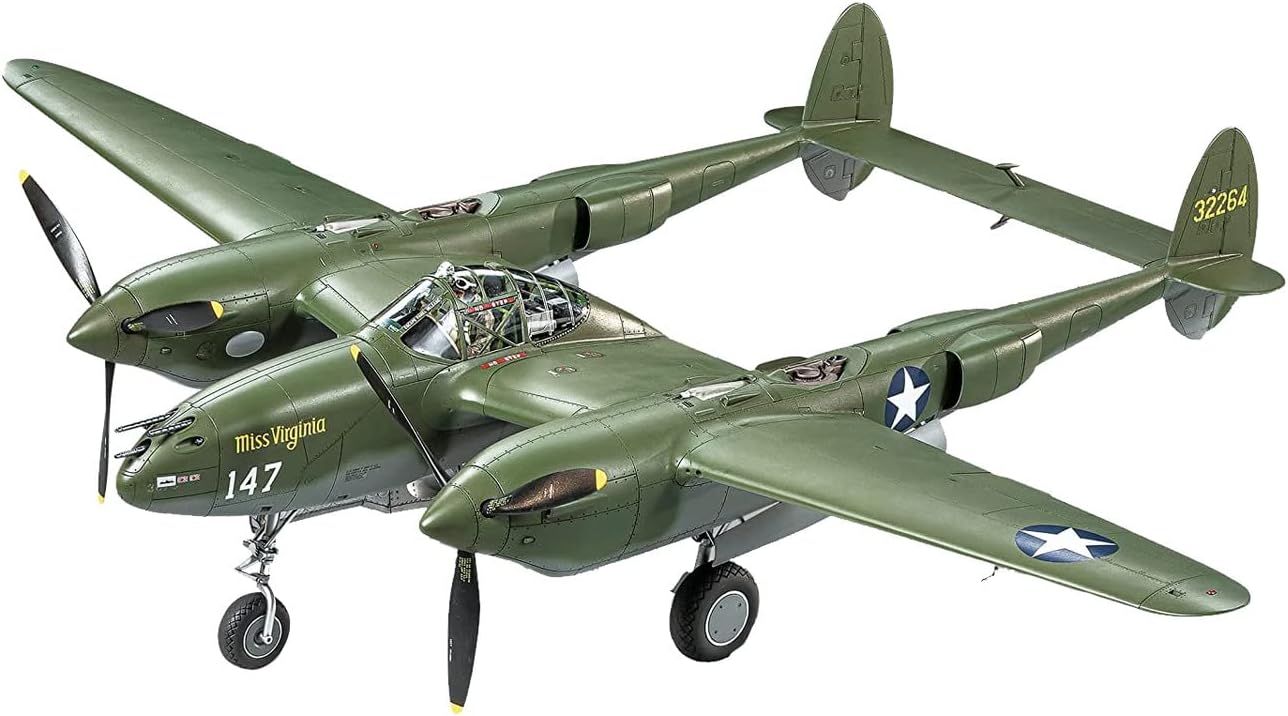
No WWII American fighter arrives at the bench with a silhouette like the P-38 Lightning’s—twin tail booms, twin Allison engines, and a central nacelle pointing all four .50-caliber machine guns and a 20mm cannon straight ahead, with no propeller arc in the way. The Luftwaffe called it the Gabelschwanz-Teufel—the “fork-tailed devil.” Japanese airmen called it “two planes, one pilot.” America’s top two aces of the entire war, Maj. Richard Bong with 40 aerial victories and Maj. Thomas McGuire with 38, flew P-38s exclusively. And on April 18, 1943, it was P-38s of the 339th Fighter Squadron, 347th Fighter Group, 13th Air Force, that intercepted and shot down the aircraft carrying Admiral Isoroku Yamamoto over Bougainville—Operation Vengeance, one of the most consequential single fighter missions in aviation history.
For builders searching for the best model airplane kits in the WWII category, the P-38 has always been the dream subject—and, historically, also a construction nightmare. Hasegawa’s 1/48 kit family, introduced in 1993, and Academy’s competing release from the same year both earned lasting reputations for boom misalignment and geometry-induced frustration that could derail even experienced builders. Tamiya’s 2019 new-tool release, Kit No. 61120, set out to change that story entirely. This review examines whether it succeeds—and whether it does so for builders who are just starting out.
Brief Overview
The Tamiya 1/48 Lockheed P-38F/G Lightning (Kit No. 61120) is a completely new-tool, injection-molded polystyrene kit of the iconic twin-boom WWII U.S. Army Air Forces fighter. First shown at the IPMS/USA Nationals in August 2019 and commercially released in October of that year, it won the Detail & Scale Reader’s Choice Award for best kit of 2019. Not a retool of any prior release—every part was designed from scratch.
The box contains 207 parts across seven gray polystyrene sprues and a dedicated clear sprue holding 18 parts, a Tamiya in-house-printed decal sheet, a self-adhesive Kabuki tape canopy masking set, three chrome steel ball bearings, and full-color double-sided A3 marking guide booklets for two historically documented aircraft. The completed model measures approximately 9.4 inches (240mm) in length with a 13-inch (330mm) wingspan.
Tamiya is a Japanese manufacturer universally recognized among scale modelers for engineering precision and fit quality that consistently sets the 1/48 aircraft standard. What makes Kit 61120 specifically relevant to beginning builders is Tamiya’s own stated design goal at release: that despite its price point, a beginner should be able to build it successfully. Four engineering decisions back that claim.
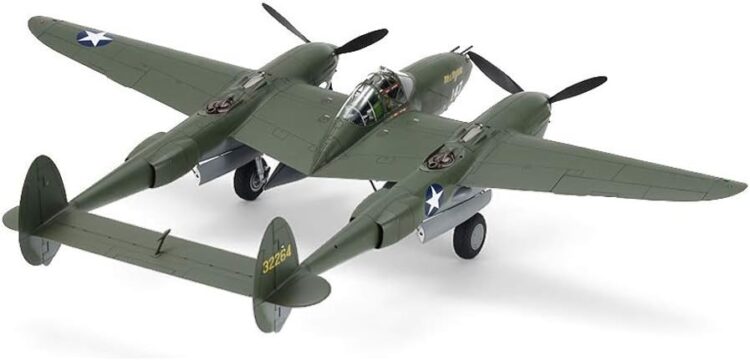
The upper wing surfaces and cockpit pod roof are molded as a single, full-span part—the structural decision that eliminates the boom alignment problem that afflicted every prior 1/48 P-38. Three chrome ball bearing counterweights, each seated in a dedicated kit-molded cradle, address the P-38’s notorious tail-sitting tendency, the resolution of which Hasegawa and Academy both left to the builder. The cockpit—firewall, both sidewalls with their electrical boxes and levers, throttle quadrant, SCR-274 radio stack, map case, and the Lightning’s distinctive twin-handled control yoke—builds up as a complete, self-contained assembly before the fuselage closes around it. And the kit provides genuine variant flexibility: separate turbocharger styles and instrument panels for the P-38F and P-38G, with drop tank options correctly keyed to both.
Check current pricing and availability on Amazon
Pros & Cons
Pros:
- No putty or gap-filling required at boom junctions, wing roots, or fuselage joins—a structural engineering achievement praised without exception across every independent build report consulted
- Three included chrome ball bearings prevent tail-sitting; factory-molded cradles position them invisibly inside the nose and both engine nacelles
- Wheel well detail—pipes, actuators, gear door linkages, structural framework—rated “some of the best” seen in any injection-molded styrene kit by Detail & Scale
- Self-adhesive canopy masking set included; reduces one of the most tedious and error-prone finishing tasks for beginning builders
- Dual P-38F/G buildability with variant-specific parts clearly identified and flagged throughout the 54-step instruction booklet
Cons:
- Decal carrier film is noticeably thick compared to Cartograph-printed alternatives; Mr. Mark Softer or equivalent aggressive setting solution is required to conform the film properly to panel lines and prevent silvering
- Kit gun barrels are the single most consistently cited weak element across all reviewed build reports—brass replacements from Master Model, Quickboost, or Eduard are strongly recommended before the nose is sealed
- Landing gear struts are fragile and vulnerable to breakage during the inevitable awkward handling of a model this shape; premature gear installation is a well-documented builder error across community build threads
- Ejector pin marks are present on gear well wall interiors; largely invisible in a finished display model, but visible to judges in an out-of-the-box competition context
Behind the Build: What Assembly Actually Looks Like
Assembly begins with the cockpit—and Tamiya’s engineering announces itself from the first step. The cockpit tub is built up from the floor plate, both sidewalls, the firewall, and multiple detail sub-assemblies. Two decisions must be made at the outset: whether to include the optional seated pilot figure (it fits the completed cockpit without modification, and it’s recommended for a display build) and which variant to build. Both the P-38F and P-38G instrument panels are supplied as separate parts, and the correct one must be identified and set aside before the fuselage halves are permanently joined. This is the variant decision point that builders who skim the instructions frequently miss—and it cannot be revisited once the pod is closed.
Decals cover the instrument dial faces and the pilot’s shoulder harness and lap belt, aligning precisely over raised instrument bezel detail. The SCR-274 radio stack on the rear cockpit deck—rendered in multiple parts—and the small map case are particularly noteworthy at this kit’s accessibility level. Cockpit interior color is Interior Green, representing USAAF Zinc Chromate Yellow-Green—Tamiya XF-71 Cockpit Green is the standard match; sidewall electrical boxes should be picked out in various grays following period reference photographs.
Before joining the fuselage pod halves, the first chrome ball bearing must be installed in its molded nose cradle between the two halves. This is the single most commonly reported beginner oversight across all community build reports. It cannot be corrected without disassembly once the fuselage is closed, so the instruction booklet’s sequencing here is not optional.
The completed cockpit tub drops into the lower fuselage half, then the upper and lower pod halves are joined. The top-to-bottom seam of the forward nacelle demands real attention: the vertical rivet lines ahead of the wing roots run directly over this join, and builders who rush the seam cleanup report losing that detail to inattentive sanding. Dry-fit twice; glue once.
Wing and boom assembly follow Tamiya’s structural logic. The single-span upper wing and pod roof part is the load-bearing foundation. Lower outer wing panels attach to it, then the boom halves are assembled in pairs. The second and third ball bearings must be seated in their nacelle cradles during boom construction—before the boom halves are permanently joined. Review the instruction sequence carefully before committing glue here; this is the step most easily missed in sequence. Once the booms are assembled, the one-piece horizontal stabilizer, Part B7, slides precisely into position and locks both booms into alignment simultaneously. This is Tamiya’s engineered solution to the defining problem of every prior 1/48 P-38. It works exactly as designed.
Landing gear bay detail is exceptional by injection-molded standards—pipes, actuators, linkages, and structural framework are all represented. Gear door hinge rails are molded into the parts, directly addressing the frustrating door installation that plagued Academy’s competing kit. Counter-rotating propellers are correctly handed and clearly marked; verify left and right assignment before any glue is applied.
Both marking options call for Olive Drab (ANA 613) upper surfaces over Neutral Gray (ANA 603) lowers—standard early-war USAAF Pacific theater camouflage. A critical note on the gray: ANA 603 is a distinctly medium-warm gray, not a light gray. Tamiya XF-22 reads slightly light to many experienced Pacific theater builders; Floquil ANA 603 or Mission Models equivalents are frequently cited as more accurate. Tamiya XF-62 Olive Drab is widely used for the upper surfaces, though some builders consider it slightly dark and compensate with post-shading.
The twin-boom P-38 presents a genuine masking challenge for beginning builders. Complex geometry, compound curves, and inside corners create situations that masking tape cannot follow without deliberate cutting and piecing. The included self-adhesive Kabuki tape masking set reduces this significantly for the canopy frames—though each shape must be individually trimmed from the sheet with a fresh No. 11 blade. Tamiya’s decals are flawlessly printed and in perfect register. Both marking options are historically specific and documented: the P-38G Miss Virginia (S/N 43-2256, 339th FS, 347th FG, 13th Air Force, Guadalcanal—one of the documented Operation Vengeance aircraft) and the P-38F White 33 (39th FS, 35th FG, 5th Air Force, Port Moresby, late 1942—featuring shark mouth nose art on both engine nacelles). The chrome oval nacelle mirror decals representing the Lightning’s distinctive inboard mirrors are particularly delicate; apply carefully with water alone and allow to fully dry before any further handling.
The carrier film thickness remains a legitimate caveat. Applying over a gloss coat is non-negotiable: Micro Set prepares the surface and aids positioning; Micro Sol softens the film to conform into panel lines. Without both, silvering on the P-38’s panel-rich surface is a realistic outcome, not a remote risk.
Three construction tips worth knowing before opening the box. Install all three ball bearing counterweights in strict sequence per the instruction booklet—nose first during cockpit assembly, then both nacelle weights before the boom halves are joined—because a missed weight means disassembly. Delay all landing gear installation until after painting, decaling, and clear coating are complete; the completed P-38 is an awkward model to handle, and the undercarriage struts are fragile. Replace the kit gun barrels before sealing the nose. Brass replacements are inexpensive and transform the forward nacelle—the one area where this otherwise exceptional kit genuinely underperforms.
Where the Tamiya 1/48 Lockheed P-38F/G Lightning Really Shines
What separates this kit from every P-38 that came before it is the experience of building it. Reviewers across independent platforms used strikingly similar language. Brett Green at HyperScale described it as a model that “will go together without any drama”—a conclusion that carries real weight from a reviewer who had built Hasegawa and Academy Lightnings and knew precisely what a difficult P-38 build felt like. Fotios Rouch at CyberModeler called it “close to perfect,” specifically citing the evident planning and design thought that went into the kit. Haagen Klaus at Detail & Scale concluded that Tamiya had produced the finest P-38 available in 1/48 scale—or in any scale. That kind of cross-platform consensus from experienced builders is not something the specification sheet generates.
For a beginning builder, the tangible wins are specific and meaningful. Clean boom junctions mean no filler work—no gap-filling and sanding that risks destroying the panel line detail beneath, and no alignment crisis while the plastic cement is already setting. The cockpit, which looks merely good on the sprues, looks markedly better once assembled—a characteristic Brett Green highlighted specifically in his HyperScale build assessment. The wheel wells, outstanding by any injection-molded standard, reward any builder who paints them carefully with a level of visible complexity that reads well above what the kit’s accessible price point might suggest.
On the shelf, a finished Tamiya Lightning commands attention in ways that few WWII fighters can match. The twin-boom silhouette is unmistakable at any viewing distance—no other WWII American fighter looks remotely like it. At 330mm wingspan in 1/48 scale, a properly built and finished example is a display case anchor. The Miss Virginia markings, historically tied to Operation Vengeance and the Yamamoto intercept, give the finished model a documented story that resonates well beyond the hobby room.
Compared to the Hasegawa P-38J or Academy P-38E/M—both of which demand real patience and experience to align correctly—the Tamiya kit delivers a better result, more reliably, across a wider range of skill levels. It supersedes both as the primary 1/48 P-38 subject for builders at any experience level.
Find the Tamiya 1/48 P-38F/G Lightning on Amazon
Who Should Buy It
If you’ve completed one or two simpler builds—a single-engine Tamiya 1/48 fighter, perhaps an F-35C or a Spitfire—and want a more challenging subject that rewards the skills you’ve been developing, this is the kit. The twin-boom geometry delivers real complexity; Tamiya’s engineering removes the fit failures that would otherwise derail an intermediate build mid-project. Tamiya’s own stated intent at release was that a beginner should be able to build it successfully—and that framing holds up consistently across the build reports reviewed for this assessment.
If you want a historically documented subject tied to a specific, named moment in American military history—not merely a generic wartime aircraft—the Miss Virginia markings option places you on Guadalcanal in April 1943 with the mission that changed the course of the Pacific war. No other P-38 kit in 1/48 scale provides this subject with comparable buildability or accuracy.
If you’re buying as a gift for a hobbyist with some kit-building experience, this is a premium, immediately recognizable release that includes everything needed—counterweights, masking, full-color marking guides, seated pilot figure—to complete a quality build straight from the box.
Absolute first-time builders who have never used plastic cement or completed a styrene kit should build a simpler, single-engine subject first. The twin-boom geometry, multi-stage counterweight installation, and canopy masking process all require a baseline vocabulary of modeling experience. Advanced competition modelers will find the kit excellent as a foundation but will want to add Eduard’s specific photo-etch detail sets—PE seat belts, boom intake grille replacements—along with resin wheel substitutes before entering out-of-the-box competition.

Key Takeaways
- Tamiya’s single-span upper wing part and one-piece horizontal stabilizer work together to solve the twin-boom alignment problem that affected every prior 1/48 P-38—no putty required.
- Install all three chrome ball bearing counterweights in strict sequence per the instructions; a missed weight means disassembly.
- Kit gun barrels are the one genuine weak point—replace with aftermarket brass before sealing the nose.
- Best suited for advancing beginners and intermediate builders; too complex for complete first-timers, needs Eduard detail sets for top-tier competition.
- Operation Vengeance markings make this one of the most historically compelling WWII Pacific builds in any scale.