


Turn a scary panel line wash for model aircraft into a satisfying six-step routine: gloss, touch, flow, wipe, inspect, and seal for crisp detail without wrecking your paint.
Why Your Panel Lines Are Crying Out for a Wash
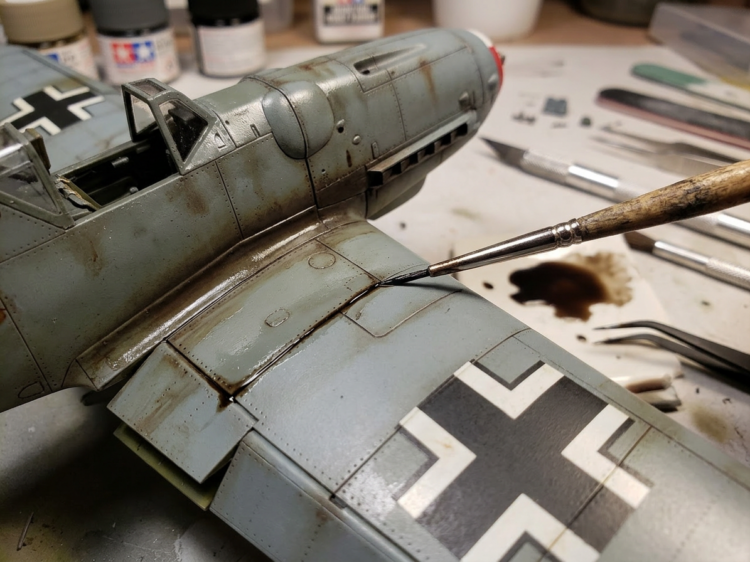 You finish the paint, peel the masks, and step back—and your freshly painted aircraft looks flat. The engraved detail you admired on bare plastic has vanished. A panel line wash on a model aircraft is the fastest fix, turning shallow grooves into shadowed structure.
A wash is paint thinned to a very translucent consistency that flows into the nooks and crannies of your model’s surface, and modelers commonly reach for a wash as an early step in the weathering sequence. A pin wash is the targeted version: you touch a fine brush to individual panel lines and let the liquid flow in on its own. The engine behind that flow is capillary action—”the tendency of a liquid to flow through narrow spaces, pores, or narrow columns without the assistance of external forces” (The Physics Classroom). Think of the brush as a delivery tool dropping a tiny puddle, and the groove as a paper towel pulling the wash along.
This is a confidence-building technique, not a high-wire act. Ahead: the tools to buy, the prep that protects your paint, a six-step process, color selection, the five most common mistakes and their fixes, and a few pro refinements.
The Science Behind the Magic: How a Wash Pops Panel Lines
Once your loaded brush touches the start of a line, the liquid travels down the groove without you dragging it there—governed by adhesive forces pulling the wash against the sides of the line and cohesive forces dragging more liquid along behind it (The Physics Classroom). FineScale Modeler notes that a pinwash lets the wash flow by capillary action to accentuate details.
Beginners often confuse three related techniques. A pin wash (panel line wash) is targeted—a fine brush touched to small details and panel lines. An overall wash is applied broadly with a large brush and allowed to pool around details. A filter is tone-shifting and, per Vallejo’s Model Wash guide, should be applied evenly and avoid build-up in crevices. The short version: a pin wash targets lines, a full wash covers an area, and a filter changes tone without collecting in lines.
Modern injection-molded kits with recessed detail are ideal for a pin wash, since the technique depends on engraved lines that can receive flowing liquid (Tamiya USA). One caution on real-aircraft analogies: the Smithsonian’s North American P-51D Mustang, displayed in 351st Fighter Squadron, 353rd Fighter Group markings, is a great reference—but a museum aircraft’s skin joints and restoration finish won’t always match a kit’s engraved layout at scale, so study, don’t copy blindly.
Your Pin Wash Toolkit: What to Buy Before You Begin
You don’t need a full weathering cabinet to start. Because availability and promotions change constantly, we won’t list prices—check current pricing at your local hobby shop or online retailers.
Essential kit: a finely pointed round brush (the best way to apply a pinwash, per FineScale Modeler); the wash itself; a compatible thinner; a gloss clear coat; cotton swabs to soak up unwanted wash; paper towel or a lint-free cloth; and a painted, glossed test surface.
Recommended kit: a flat clean brush for cleanup (Vallejo); an old stiff brush; a desk lamp for low-angle inspection; and nitrile gloves plus ventilation—Winsor & Newton advises using Artists’ White Spirit with caution, and Gamblin recommends washing hands after every painting session.
Optional kit: commercial panel-liner sets (AK Interactive; AMMO by Mig Jimenez), artist’s oils with odorless mineral spirits (Gamblin Gamsol), a magnifier, microbrushes, and pre-cut sponges.
Paint Types for Your Wash
Enamel washes are the traditional, beginner-friendly choice. Tamiya’s Panel Line Accent Color is enamel-based and pre-diluted—Tamiya USA states, “The paint has been pre-diluted into the ideal viscosity and can be easily applied into crevasses such as panel lines with the brush on the bottle cap”—but also warns, “Note: Plastic parts may become brittle when using Tamiya Panel Line accent colors.” AK Interactive says its “Precision panel liners are formulated with a blend of enamel-based products that allow the paint to flow efficiently by capillary action without spreading or staining large areas,” and its enamels dissolve with white spirit or odorless thinner (AK aircraft engine wash). Humbrol’s enamel washes create weathered effects and dry in 10–20 minutes, while AMMO offers surface-specific colors like Blue Black for light metallic surfaces. Enamels flow and clean up best on gloss but punish poor compatibility hardest, so the gloss coat underneath is essential (Large Scale Planes).
Oil washes use artist’s oils—raw umber, burnt sienna, ivory black—thinned with white spirit or odorless mineral spirits. Gamblin describes Gamsol as odorless mineral spirits for thinning oil colors, while Winsor & Newton describes Artists’ White Spirit as less hazardous than turpentine but still requiring caution. Oils excel at color control—raw umber for shadow, burnt sienna for warm dirt, ivory black sparingly in deep recesses—but stay workable longer, which can slow your schedule.
Acrylic and clay washes are the most forgiving for solvent-sensitive beginners. Vallejo states, “A wash is a transparent and very liquid acrylic color,” and its Game Color formulation enhances capillary properties. Flory Models describes its clay-style wash as an apply-dry-wipe-off system in nine colors, adding, “The best bit is, if you don’t like it, just wash it off and start again.” Just remember that “forgiving” isn’t “careless”—water-based products can still stain flat or porous surfaces.
Ready-made washes offer convenience and color range; treat them as convenience products, not requirements. Tamiya USA advises that black is general-purpose, brown suits military models and bright colors, and gray suits white or light gray parts where black may be too distinct.
Brushes, Solvents, and Protective Coats
For brushes, use a round brush in sizes 0 to 000 for application, a flat wide brush for removal, and an old stiff brush for stippling; AK Interactive notes its precision brush carries paint to highlight lines in one pass. A size 0 or 00 works for 1/48 lines, 000 for 1/72 cockpits. The brush is a delivery tool, not a pencil.
Match the cleanup liquid to the wash: enamel thinner for Tamiya, white spirit or odorless thinner for AK enamel-based washes (AK Interactive), Humbrol Enamel Thinners for Humbrol, Airbrush Thinner for Vallejo (water thins it but won’t remove dry effects, per Vallejo), and a damp cloth for Flory. Use “odorless” carefully—odorless mineral spirits are still a solvent. The safest beginner rule is “damp, not wet.”
A gloss coat before washing is not optional: FineScale Modeler says the model must be glossy so the wash goes on better and comes off more easily, and a gloss coat protects the paint during cleanup (Large Scale Planes). Reliable options include Tamiya X-22 Clear (X colors are glossy, XF flat, per Tamiya USA), Vallejo Gloss Acrylic Varnish, and Mr. Super Clear Gloss. Apply thin layers, not one thick one, since thick varnish causes unpredictable drying (Vallejo). Gloss reduces staining and cleanup friction, but it doesn’t make mistakes impossible.
Set Up for Success: Prep Your Model Before You Open Any Bottle
Proper preparation prevents poor performance. The prep stage decides whether your panel line wash flows cleanly or fights you all the way.
- Finish construction and painting first. A panel line wash goes on after the base coat and decals—never on bare plastic or primer alone.
- Wash injection-molded parts before assembly. Revell’s FAQ notes that residual mold release from manufacturing is one common cause of paint bubbles and recommends washing the model with dish soap and drying thoroughly; Revell instruction sheets reinforce this, linking a mild-detergent wash to better paint and decal adhesion. It’s cheap insurance against skin oils, dust, and manufacturing residue.
- Apply a full gloss coat. This seals the base paint, protects decals, and creates the smooth surface that lets the wash flow without staining surrounding paint (FineScale Modeler; Large Scale Planes).
- Let the gloss coat cure fully. Allow a minimum of about 24 hours for enamel-based clears and roughly 12–18 hours for acrylic gloss coats—minimums that vary with product, humidity, and temperature, so manufacturer instructions win. Vallejo recommends at least four hours between varnish coats and 24 hours for washes to dry on base colors.
Tip box — Work one section at a time. Tackle a single wing top, fuselage side, or tailplane rather than the whole model. Vallejo says it’s important to work in sections and study each component separately—so you learn drying behavior and staining risk on a small area before committing the whole airframe.
The Foolproof Process: Applying Your Panel Line Wash in Six Steps
No technique is truly foolproof, but this sequence is beginner-safe because it adds a control point before, during, and after cleanup. The spine: gloss, touch, wait, wipe, inspect, seal.
Step 1 — Mix your wash. For a DIY enamel or oil wash, aim for roughly 80–90% thinner to 10–20% paint—a consistency like very weak tea, not milk. FineScale Modeler defines a wash as paint thinned to a very translucent consistency that flows into nooks and crannies. “Weak tea” means transparent enough to tint a line, not thick enough to paint a stripe; a pre-diluted product like Tamiya Panel Line Accent removes the guesswork (Tamiya USA). Test on a painted, glossed scrap spoon—not bare sprue, which doesn’t mimic your finish.
(Photo: a bottle cap holding a small puddle of diluted wash, beside a painted, glossed test spoon.)
Step 2 — Touch the wash to the panel line. Load a fine round brush (size 0 or 00) and lightly touch the tip to the start of a line, letting capillary action carry the wash along the groove (FineScale Modeler). Don’t flood the line. If a bead forms, you have too much wash on the brush or the surface isn’t glossy enough. The motion is “touch and pause,” never “draw a line.”
(Photo: a size 0 brush just touching one recessed line, with a dark line extending away from the tip.)
Step 3 — Work in sections. Complete one face—say, the port fuselage side—before moving on, treating wing tops, fuselage sides, tailplane, belly, and nacelles separately. Vallejo supports working in sections, which keeps the first panel from drying before the last is applied.
(Photo: masking-tape flags marking the “active” section so the reader sees the limited working area.)
Step 4 — Let the wash dry to a “tacky-dry” state. For enamel washes at room temperature, that window is roughly 15–30 minutes—Humbrol lists 10–20 minutes for its washes and Large Scale Planes reports AK guidance of a 5–10 minute wait, so times vary by product. One FineScale Modeler workflow noted a 15–30 minute dry window for a water-based sludge wash and that wet areas look shiny while dry areas look flat. Follow the bottle first, then adjust on a test piece. “Tacky-dry” means no longer a wet puddle, but still movable by the cleanup medium.
(Photo: a close-up where the wet gloss around the line has dulled, but the panel line stays visibly darker.)
Step 5 — Remove the excess. Wipe the flat surfaces with a nearly dry flat brush or cotton swab, in straight strokes following the airflow direction. Use enamel thinner for Tamiya (Tamiya USA), white spirit or odorless thinner for AK (AK Interactive), Airbrush Thinner for Vallejo (Vallejo), or a damp cloth for Flory. FineScale Modeler notes that cotton swabs lift excess with light pressure and that rolling the swab avoids buildup. Don’t scrub—one deliberate stroke per pass. A “nearly dry” brush is crucial, because a soaked one pulls wash back out of the groove.
(Photo: a flat brush drawn from leading edge to trailing edge, residue gone from the panel center but dark in the engraved line.)
Step 6 — Inspect and refine. Hold the model under a single, low-angle desk lamp to reveal streaking, tide marks, and missed lines that overhead light hides. FineScale Modeler notes that thin areas can be reapplied and a wash can be removed and restarted, and IPMS/USA warns against uneven finish, brush marks, and inappropriate glossiness from washes. Touch-up means one more thin wash or one faint smear removed—not repainting the model.
(Photo: the wing under a low lamp with shadowed panel lines visible, plus an inset of one panel before and after cleanup.)
Which Wash Color? Match the Shade to the Subject
Color depends on the base coat, service history, and the contrast you want. The beginner rule is “choose a shadow, not an outline.” FineScale Modeler warns that black panel lines on an all-white airplane are too stark and recommends medium gray, and Tamiya USA advises gray where black may be too distinct.
- Light gray / silver / bare metal → neutral or dark gray, or blue-black (AMMO lists Blue Black for light metallic surfaces).
- Olive drab / dark green → raw umber or dark brown, black only sparingly; AMMO offers Neutral Brown and a Dark Brown Wash for Green Vehicles.
- Desert sand / tan → raw umber, sepia, or burnt sienna.
- White / light blue undersides → neutral gray or gray-brown.
- Dark sea blue / very dark camouflage → medium gray, blue-black, or stone gray, with black only in deep recesses (AMMO).
For well-maintained WWII fighters and modern jets, a subtle dark gray or brown wash is almost always the right call. Treat “never pure black” as a rule of thumb, not an absolute—black still earns its place in flap gaps, gear wells, intakes, and exhaust recesses, or on heavily worn subjects.
Don’t Panic: Troubleshooting the Five Most Common Pin Wash Problems
Every one of these has a fix. The trick is catching them before you seal the model.
- Tide marks or halos. Usually too much wash, too much cleanup liquid, or a too-flat surface. Fix: re-gloss the area, let it cure, then remove again with fresh, nearly-dry mineral spirits—gloss makes the wash go on and come off more easily (FineScale Modeler), and Vallejo notes Airbrush Thinner can correct paint rings.
- The wash won’t flow. Usually an insufficient or too-rough gloss coat, a too-thick mix, or dust bridging the groove. Fix: re-gloss and thin the wash further—flow is pure capillary action (The Physics Classroom), and washes can be diluted with the maker’s thinner (Vallejo).
- The wash lifts or smears the base paint. Usually a gloss coat that hasn’t fully cured, or too-aggressive thinner. Fix: use odorless mineral spirits instead of stronger white spirit and let the gloss cure fully—gloss protects the paint and lets excess come off without scrubbing (Large Scale Planes), and both Winsor & Newton and Tamiya USA counsel caution with solvents and plastic. Test on the underside first.
- Lines look too dark. Too much pigment or black on a light subject. Fix: thin further, switch to brown-gray, re-gloss, and retry (FineScale Modeler; Tamiya USA). Stop when the lines read under ordinary room light, not from across the room.
- Decal carrier film lifts. Enamel thinner reaching improperly sealed decals. Fix: seal decals under gloss before any enamel wash, and wipe away from markings. Decal quality is part of finish quality (IPMS/USA), and FineScale Modeler’s workflow ends with a clear overcoat to seal wash and decals. Let decals dry fully first, and keep cleanup over them light and brief.
Level Up: Six Pro Tips That Separate Good from Great
Once you’ve completed one straightforward pin wash, these refinements add polish.
- Use a single raking light. A low desk lamp reveals streaking and missed lines invisible under overhead lighting and keeps you from chasing false shadows—matching IPMS/USA finish criteria for an even, smooth finish free of brush marks, lint, and wash glossiness.
- Apply multiple thin washes, not one heavy one. On a complex subject like a B-17 Flying Fortress or a twin-boom P-38 Lightning, build depth gradually—Vallejo favors thin layers for predictable drying. Stop after the second pass instead of erasing one heavy black one.
- Vary your wash color. Use a warmer brown wash on undersurfaces and a cooler blue-gray on top surfaces; Vallejo supports treating each component separately, and AMMO offers tones for desert, metallic, blue, green, and dark surfaces.
- Lift wash from rivets with a dry brush. A nearly-dry flat brush leaves wash in grooves while lifting it off raised rivet heads, which otherwise look like polka dots—the same gentle cleanup logic as Vallejo and FineScale Modeler.
- Dampen the line with pure thinner first. Touch a little pure thinner into the line, then the wash—the wash flows only where the surface is wet, for pinpoint control. Optional, because too much thinner can spread wash or create halos; the foundation is still capillary action (The Physics Classroom).
- Seal in every layer. Apply a clear coat between the wash and the next weathering step—FineScale Modeler’s workflow ends with a clear overcoat to seal wash and decals. Seal only when satisfied, because sealing a halo makes it harder to correct.
Your Panel Line Wash Questions, Answered
How do I step-by-step apply a panel line wash to my scale model aircraft without ruining the paint job?
A panel line wash is applied safely in six controlled steps over a fully cured gloss coat that protects the underlying paint.
- Apply a gloss coat first—it makes the wash go on and come off more easily and protects the paint (FineScale Modeler; Large Scale Planes).
- Mix a thin wash at about 80–90% thinner to 10–20% paint, or use a pre-diluted product (Tamiya USA).
- Touch a fine brush to the line and let capillary action carry the wash in (FineScale Modeler).
- Let the wash reach a tacky-dry state.
- Remove excess with the compatible medium—enamel thinner, white spirit, Airbrush Thinner, or a damp cloth.
- Inspect under raking light, refine, then seal when satisfied.
What is the exact process for removing enamel panel line wash excess without streaking?
Removing enamel wash excess cleanly requires a nearly-dry flat brush or Q-Tip loaded with odorless mineral spirits, wiped in straight strokes following the airflow direction.
- Use the maker’s compatible thinner—enamel thinner for Tamiya, white spirit or odorless thinner for AK (Tamiya USA; AK Interactive).
- Use single deliberate strokes, never circular scrubbing.
- Use cotton swabs with light pressure for tight areas (FineScale Modeler).
- Work in sections so the wash doesn’t dry unevenly.
- Re-gloss and repeat if staining persists.
Can I use an oil paint wash instead of a ready-made panel line wash on my 1/48 scale aircraft model?
Artist’s oil paints thinned with odorless mineral spirits make an excellent, economical panel line wash that performs the same role as commercial products over a protected gloss surface.
- Choose raw umber for brown-gray shadow, ivory black for very dark recesses, or burnt sienna for warm dirt.
- Thin the oil color with a product like Gamsol (Gamblin).
- If you use white spirit, handle it with caution and dispose of it responsibly (Winsor & Newton).
- Apply over a gloss coat, then seal only after the wash dries and the color looks right.
What color panel line wash should I use on a Tamiya 1/48 P-51D Mustang painted in olive drab?
For an olive drab subject like the P-51D Mustang, a raw umber or dark brown panel line wash gives the most realistic, in-scale result for a beginner. (FS numbers for WWII olive drab are contested—see the note at the end of this answer)
- Avoid pure black—it’s often too stark, and gray is recommended where black may be too distinct (FineScale Modeler; Tamiya USA).
- Reach for raw umber or burnt sienna oils, or AMMO’s Neutral Brown / Dark Brown Wash (AMMO).
- Apply sparingly—a well-maintained USAAF fighter like the Smithsonian’s P-51D warrants subtle weathering unless a reference photo supports heavier grime.
- Talk “olive drab” in plain terms rather than chasing one exact Federal Standard number: records disagree, with a S. Army color guide mapping ANA 613 Olive Drab to FS 34088 while the 1964 ANA Bulletin 157e lists it as “2/X 34087.”
Do I need to seal decals before applying a panel line wash?
Yes—seal decals under a smooth gloss coat before washing so cleanup doesn’t drag pigment under decal edges or lift the carrier film.
- Gloss sealing matches FineScale Modeler’s workflow, which applies the wash after a clear gloss and ends with an overcoat (FineScale Modeler).
- Decal quality is part of finish quality (IPMS/USA).
- Let decals and setting solutions dry fully before applying gloss.
- Wipe away from decal edges, and use the least cleanup liquid needed.

Key Takeaways
- A gloss coat applied before washing is the single most important step—it determines whether the wash flows cleanly and whether cleanup is possible.
- Capillary action does the work: a wash thinned to roughly 80–90% thinner and 10–20% paint flows through recessed lines from a light brush touch.
- Odorless mineral spirits are the safest, most controllable cleanup solvent for enamel and oil washes—keep the brush damp, not wet.
- Match wash color to the base coat: dark gray or brown for most subjects, with pure black reserved for heavily worn aircraft.
- Inspect under a single raking light and seal each layer once you’re satisfied.