


The trigger decides what you can change while the paint is still flying. Here’s how to match the mechanism to the airplanes you actually build — and what to check on air, fittings, parts, and safety before you pay.
Quick Answer: Which Trigger Type You Should Buy
Buy a double-action airbrush if you need paint flow to change in the middle of a pass — soft camouflage demarcations, mottling, blended fades. Buy a single-action airbrush if your near-term work is primer, overall base coats, clear coats, and hard-masked schemes. That is the heart of the single vs. double action airbrush decision, and it follows from the mechanism rather than from any scoreboard.
On a double-action tool, the trigger does two jobs: press down for air, draw back for paint, and the farther back you draw, the more fluid you get. On a single-action tool, the trigger runs the air and a separate fluid adjustment sets how much paint comes out. Both are legitimate configurations, though neither manufacturer is neutral about it: Iwata’s airbrush basics reference says new users quickly outgrow single-action and that nearly all its own airbrushes are dual-action, while Paasche pitches the single-action H#3L as needing less practice than a dual-action for basic spraying.
Here’s the qualification that belongs up front, not buried in a footnote: the trigger is not the variable that decides whether your finish looks good. Iwata’s own troubleshooting guidance lists paint that is too thick, inadequate pressure, dried paint on the needle, and a dirty airbrush as separate, distinct causes of a bad spray pattern. None of them care which trigger you bought. Read the criteria section below — needle and nozzle, feed, air supply, spare parts — before you let the trigger question absorb your whole budget.
Who This Guide Is For — and Who Can Skip It
This guide is written for people choosing a first or replacement airbrush for scale aircraft:
- The first-time buyer who has been hand-brushing 1/72 and 1/48 airframes and wants softer demarcations than a brush will give.
- The owner of a starter set bundled with a can of propellant, trying to work out whether the next purchase should change the trigger type or something else entirely.
- The returning modeler re-equipping a bench after years away, who needs to know what’s changed in the spec lines.
It is not written for automotive custom painters, illustrators, nail artists, RC-scale finishers coating large surfaces, or anyone shopping single-purpose high-volume spray guns. Those buyers weigh the same criteria very differently.
Scope: the comparison here is the trigger mechanism. Feed type, nozzle diameter, compressors, and full painting tutorials appear only where they change the buying decision. And one honest exclusion: if your current method already gives you the finish you want, nothing below argues that you must replace it.
One more thing to get out of the way. Scale by itself does not specify an airbrush. A 1/72 kit does not require one nozzle size and a 1/32 kit another. What specifies the tool is the range of effects you intend to produce and the amount of paint you need to move.
Single-Action vs. Double-Action Airbrushes: How They Actually Differ
Before comparing anything, get the vocabulary straight — because feed position, mix location, and trigger action are three separate properties, and catalogs mix them freely.
What “Single-Action” Means at the Trigger
Press the trigger and you get air. Release it and the air stops. Paint delivery is set beforehand by a separate fluid adjustment, and changing it means stopping to make that adjustment. Backward trigger travel does nothing.
Paasche’s H#3L is the textbook example of the configuration: single action, external mix, siphon feed, with a #3 head measuring 0.65 mm. Paasche lists its operating pressure at 20–75 psi — a specification for that model, not a starting point for beginners on every paint. Worth noting before you price it: Paasche lists the H#3L as shipping as the airbrush only — no bottle, no hose.
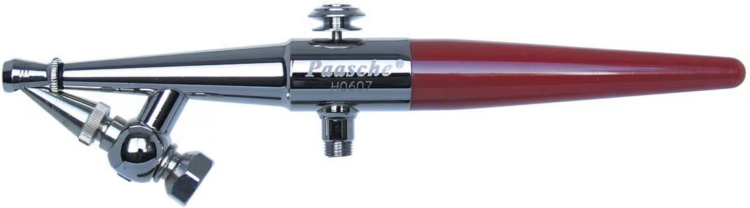
The practical consequence is straightforward. A preset output is exactly what you want for a repeatable, even pass. What a single action will not do is vary the paint with the trigger mid-stroke. It is worth saying clearly that this does not mean a single action can only make one line width; distance, fluid setting, and other conditions still change what lands on the model.
What “Double-Action” Means at the Trigger
One spring-tensioned trigger controls both variables: down for air, back for paint. Air goes on first, paint comes in second, paint comes off, then air stops — that order is the mechanism, not a stylistic preference. Robin Carpenter’s Airbrushing Scale Model Aircraft (Crowood Press, 2018) walks through the same air-then-paint sequence in its Chapter Three practice material.
The Iwata Eclipse HP-CS, item ECL4500, is the manufacturer’s own listed example: dual action, gravity feed, a 7 ml cup, and a compression-fit nozzle.
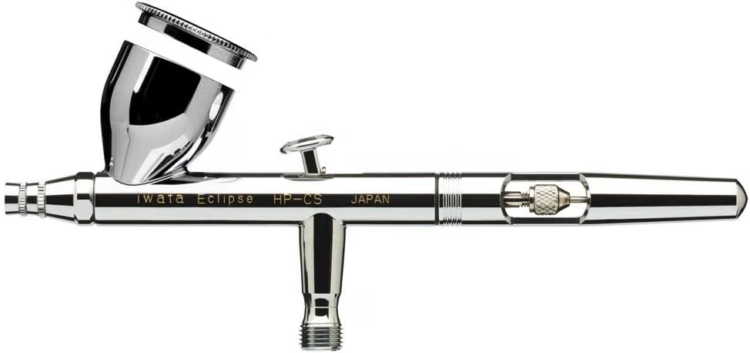
⚠ Terminology note: “dual action” and “double action” name the same arrangement. Iwata uses “dual action”; plenty of retailers say “double action.” Don’t pay twice for the same thing under two names.
And be honest with yourself about what the extra control buys. Modulating paint at the trigger is a capability, not a result. Iwata itself frames dual action as an additional learning choice a beginner takes on.
Trigger-Action (Pistol-Grip) Airbrushes: The Third Option Beginners Miss
Some airbrushes replace the top lever with a spray-gun-style trigger. Iwata identifies its HP-TH and Neo TRN1 as dual-action trigger-style models and observes that people who find the usual top lever awkward may prefer the arrangement.
This is worth flagging for readers with limited finger dexterity or hand fatigue. Two cautions, though. First, this is a different way of operating a double action — not a third category of air and paint control. Second, hand comfort is individual. If you can put your hand on the actual tool before ordering, do it; the shape of a grip in a product photo tells you very little about how your hand will feel after an hour.
Four Variables People Confuse With Trigger Type
Trigger action is independent of all of the following, and each has its own spec line:
- Feed — gravity, siphon/bottom, or side.
- Mix location — internal or external. Iwata describes external mix as generally coarser than internal mix; treat that as the manufacturer’s comparative characterization of the two designs.
- Needle and nozzle diameter.
- Nozzle construction and head assembly — compression fit versus threaded, and what it takes to reseat it.
⚠ Terminology Trap
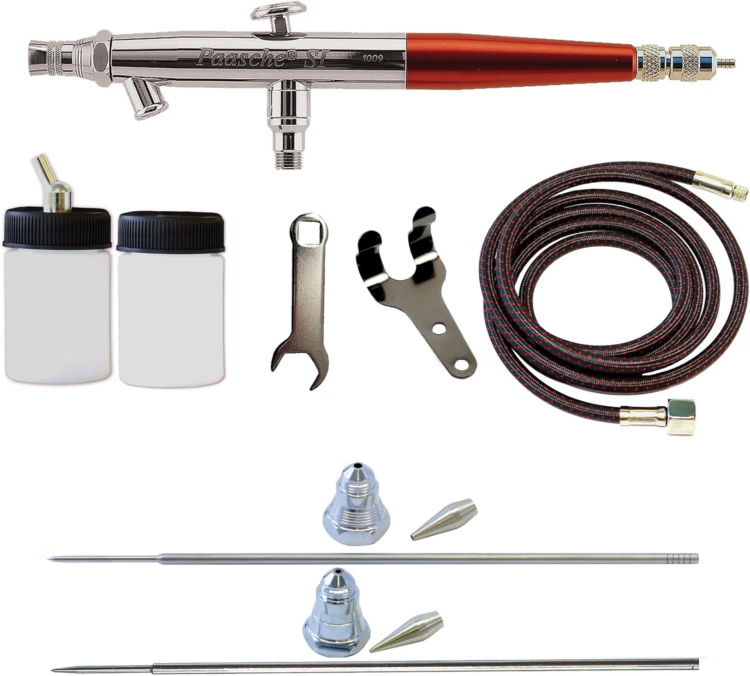
A single-action airbrush is not automatically external mix, and a double-action airbrush is not automatically gravity feed. Paasche’s SI-SET is single action and internal mix. The Eclipse HP-CS is dual action and gravity feed. Read the spec lines — trigger action, feed, mix, head assembly, paint capacity — one at a time. Don’t infer any of them from the marketing photo.
The Essential Buying Criteria, in Priority Order
Work down this list in order. Each criterion tells you what it governs and where the spec sheet stops being useful.
Criterion 1 — Match the Trigger to the Work You Actually Paint
Write down your next three aircraft projects and the finish each one needs. If those finishes depend on changing paint flow during a stroke — soft demarcations, mottling, blending, subtle weathering — shortlist double action. If they are primer, overall base coats, clears, and hard-masked camouflage, single action does that job with less to go wrong.
A blunt caveat: masks produce a hard demarcation with either trigger. Buying double action for mottle and never practicing will not beat buying single action and masking well.
Criterion 2 — Needle and Nozzle Diameter
Carpenter’s Chapter Three describes progressively larger nozzle bands for progressively broader coverage, and that logic holds — a finer head for fine effects, a larger one for area coverage. But Iwata cautions directly that needle and nozzle diameter alone gives an incomplete picture of how a tool sprays. The defensible approach is to evaluate the whole head design, its material, the paint you’ll run through it, and the coverage you need, then check the documented spray range for the specific model you’re considering.
Ask the seller for the exact head assembly and confirm replacement parts exist for it. Iwata’s FAQ page is explicit that a supported size conversion requires matching needle, nozzle, and nozzle cap — and that the company generally discourages conversion and treats it as voiding the warranty. Do not plan a purchase around swapping a nozzle later.
Criterion 3 — Paint Feed: Gravity, Siphon, or Side
Iwata’s guidance sorts the three cleanly. Gravity assists flow and can support lower working pressure. Siphon feed draws from a jar below, suits larger paint quantities, and asks the compressor to lift the fluid. Side feed offers different cup and bottle positions.
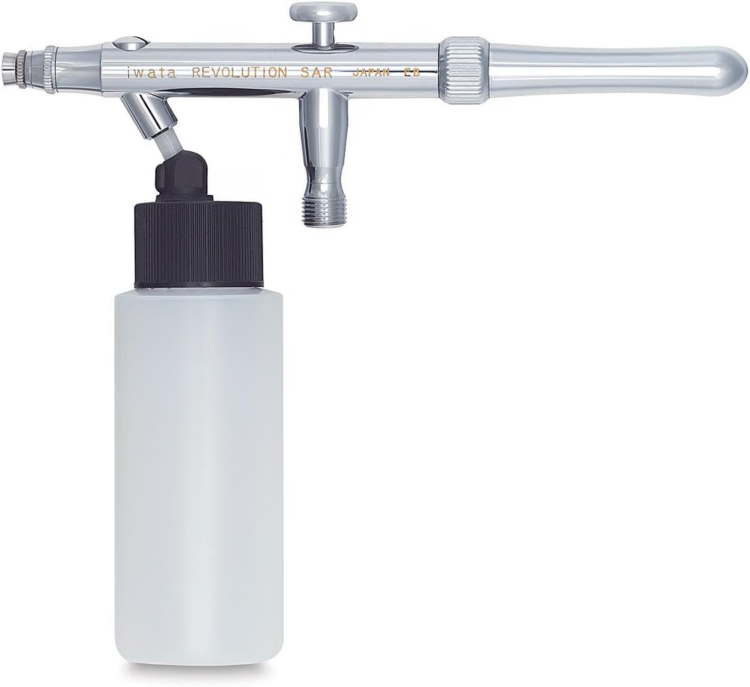
Capacity is where this gets concrete: the Eclipse HP-CS carries a 7 ml (0.24 oz) cup, while the Iwata Revolution HP-SAR, item R1000, ships with a 30 ml (1 oz) bottle. For one small detail color, a small gravity cup saves you preparing a jar. For a large overall coat, more fluid capacity means fewer interruptions. A bigger reservoir does not by itself produce a better finish.
Criterion 4 — Nozzle Design and Serviceability
Iwata calls the Eclipse nozzle compression fit and describes it as easy to clean and assemble; its cleaning instructions give compression-fit and threaded nozzles separate procedures, warn against over-tightening either, and tell you not to put a nozzle wrench on a compression-fit nozzle at all. The Revolution HP-SAR, by contrast, is listed with a screw-on nozzle in its technical table.
Easier to handle does not mean indestructible. Iwata’s warranty excludes accidental nozzle damage and normal wear. Before you buy, ask a practical question: can you clean this particular head, reseat it correctly, and get a replacement when you need one?
Criterion 5 — Handles: The Feature That Blurs the Categories
Two handle options change the buying math:
- Preset handle: limits rearward lever travel so a chosen line width becomes repeatable.
- Cutaway handle: exposes the needle chucking nut for a quick flush without stripping the tool.
The Eclipse HP-CS page describes a quick-flush cutaway handle in its overview while its technical table lists the handle type as single cut; neither entry lists a preset handle as included.
⚠ Preset Is Not Single Action
A preset handle caps how far the trigger travels back. It does not mechanically convert a double-action trigger into a single-action one — the trigger still controls both air and paint. Buy the preset if your workflow needs repeatable delivery, and confirm it’s in the box you’re actually ordering.
Criterion 6 — Air Supply Is Part of the Purchase
The airbrush is half the system. Iwata’s compressor guidance identifies the regulator as the device that sets pressure and the moisture filter as the part that removes water, and notes that canned air is limited in duration — worth reconsidering if you’ll be spraying regularly.
Manufacturer working-pressure figures are model-specific. Iwata lists 25–35 psi as optimal for the Eclipse HP-CS and 20–30 psi for the Revolution HP-SAR. Those numbers describe those tools — note that the gravity-feed Eclipse carries the higher range, which is a reminder that these are head-and-flow figures for a specific model, not a gravity-versus-siphon rule. They are not universal instructions for every paint. Check your regulator while air is flowing, since a static gauge reading can flatter you, and confirm your air source can actually meet the airbrush’s stated requirement.
Criterion 7 — Spare Parts, Service, and Support
Iwata identifies needles and nozzles as the parts that wear or get accidentally damaged, and publishes a model-specific parts finder and manuals. That is what an actionable parts check looks like: find the model number, pull the diagram, identify the matching part, confirm it’s available to you now, and read the warranty terms. Brand reputation is not a substitute for confirming the part for your exact model can be bought today.
Which One Belongs on Your Bench? Recommendations by Use Case
These are configuration shortlists tied to the work you intend to do — not ranked winners.
By Scale and Subject
If you’re chasing small freehand camouflage, shortlist a controllable dual-action tool with a cup sized for small color batches. If you’re coating a broad airframe, compare larger cups or siphon jars; the 7 ml Eclipse HP-CS cup and the 30 ml bottle supplied with the Revolution HP-SAR bracket two very different workflows.
With a mixed stash, look hard at a versatile documented head and a workable reservoir before buying a dedicated fine-detail tool that can’t handle a whole wing. Again: match the tool to the paint coverage and schemes you’re planning, not to a scale number.
By Task
| Task | What you need from the trigger |
| Primer, solid base colors, uniform clears | Repeatable, preset delivery — set it and hold it |
| Hard-masked camouflage | Either trigger; the mask makes the edge |
| Soft demarcations, mottling, blended fades | Direct control of paint output during the pass — double action |
| Fine freehand lines and shading | Direct control of paint output during the pass — double action |
Diameter stays a product-specific check. Confirm the documented spray range for the model in front of you rather than a generic chart.
By Budget Tier — Qualitatively
Describe tiers by what you can verify, not by what a price implies. Paasche currently offers a simple single-action, external-mix H#3L and a single-action, internal-mix SI-SET, the latter listing three head sizes — verify the exact package a retailer is shipping. Iwata offers the dual-action Eclipse HP-CS with its compression-fit head and single-cut handle.
Those documented features support different shortlists. What they don’t support is a quality ranking. The things you can check before paying are supported parts, handle type, cup or jar, head assembly, fittings, and manuals — so make those the basis of the decision, and price the whole usable setup at checkout rather than the airbrush alone.
Side by Side: Single Action vs. Double Action at a Glance
The table compares controls. It is not a verdict on finish quality, which depends on the specific model, the paint, and the operator.
| Buying question | Single action | Double/dual action |
| What does the usual top trigger govern? | Air | Air on depression; paint with rearward travel |
| How is paint delivery changed? | Separate fluid adjustment | Rearward trigger travel while spraying |
| Can paint delivery change during one uninterrupted pass using the trigger? | No | Yes |
| Can it give repeatable output? | Yes, once the fluid control is set | Yes, with controlled trigger use; a model-equipped preset can limit travel |
| Is it necessarily external mix or siphon feed? | No — the Paasche SI-SET is internal mix | No — the Iwata Eclipse HP-CS is gravity feed |
| Is either automatically cheaper, easier to clean, or better built? | Not by trigger designation | Not by trigger designation |
What Spending More Actually Buys You
Move up a catalog and the documented differences are concrete: cup size, nozzle construction, handle features, and the depth of the parts chain behind the tool. The Eclipse HP-CS gives you a 7 ml cup, a compression-fit head, and the quick-flush handle Iwata’s overview describes (listed as “single cut” in its own spec table). The Paasche SI-SET gives you interchangeable listed heads. Those are features, and they are checkable.
So the defensible spending question isn’t “is the expensive one better.” It’s this: does this specific added feature, documented parts supply, or service route solve a problem you already know you have? A cutaway handle solves fast flushes between colors. A compression-fit head solves reassembly anxiety. Multiple heads solve a range-of-coverage problem. If a feature doesn’t map to a task or an ownership headache you can name, it isn’t buying you anything yet.
What Ownership Costs After the Box Is Open
The purchase price is the entry fee. Budget for:
- Cleaning supplies matched to your actual coating. Iwata’s cleaning guide advises cleaning between colors and again at the end of every session. Use the cleaner and thinner your paint manufacturer specifies.
- Wear parts. Needles and nozzles are replacement items by Iwata’s own account, and accidental nozzle damage and normal wear fall outside its warranty.
- Infrastructure. Compressor, regulator, moisture filtration, hose, and any adapter you need to connect the two ends.
- Time. Cleaning after every session isn’t optional maintenance; it’s part of the hobby.
A cheap airbrush is not a cheap setup if it arrives needing a new compressor, adapters, and early replacements. Price the system.
⚠ Safety First
Ventilation and respiratory protection depend on the specific paint and thinner you spray, not on the airbrush. The U.S. National Institute for Occupational Safety and Health sorts respirators by what they actually remove — aerosols, gases and vapors, or a combination — and says choosing the right one means identifying the real hazard and the amount of exposure, with effectiveness depending heavily on fit. Read the safety data sheet for the exact products you’re using and set up ventilation and protection for those products. Do not assume a particulate mask removes solvent vapor, or that one hobby booth makes every coating safe.
Pitfalls, Limitations, and Buying Mistakes
The Mismatches That Waste Money
Three mismatches account for most buyer’s remorse, and each has a specific consequence rather than a vague one:
- A small reservoir against a broad coat means repeated refills mid-job, with all the interruptions that implies.
- A siphon-feed tool on marginal air can demand more pressure than a gravity model, because the compressor has to lift the fluid.
- A fixed fluid control cannot change paint delivery by trigger movement, full stop — no technique substitutes for the mechanism.
And note what a bigger nozzle or a fancier trigger does not fix: poor thinning or an air supply that can’t deliver. Iwata’s troubleshooting material treats those as separate faults for a reason.
Warning Signs in Listings and Sellers
These are reasons to ask questions, not accusations of fraud:
- No exact model number, only a descriptive marketing label.
- No clear statement of the head and cup actually included.
- No manual, parts diagram, or replacement-part source.
- An unidentified air fitting.
Ask for written clarification of the boxing, included accessories, warranty, returns, and parts source before you pay. Work from the listing to the manufacturer’s model page to the manual or diagram, then back to the seller.
Even a manufacturer’s page can carry an inconsistency. Iwata’s Revolution HP-SAR page describes the tool as siphon feed in its name, overview, and supplied bottle, while a field in its technical table reads gravity. Treat that as an unresolved discrepancy on the page and confirm the specific item or its manual before relying on it.
Compatibility Checks Before You Order
Hose threads are not universal. Paasche lists a ¼-inch–20 Paasche-thread air inlet for the H#3L, along with adapter options. Confirm both ends — airbrush inlet and hose or compressor outlet — and obtain the documented adapter if they don’t match.
On the fluid side, Iwata states that its needle, nozzle, and cap are model-specific parts. A matching brand name on a box does not guarantee a quick disconnect, paint, or replacement nozzle will fit.
Problems That Look Like a Bad Airbrush But Aren’t
Before you start a return, run the manufacturer’s checks. Iwata’s troubleshooting lists dried paint on the needle, paint that’s too thick, inadequate pressure, a loose needle chucking nut, a clogged nozzle, and a dirty airbrush among the distinct causes of skipping, failure to spray, or spattering. Its reassembly guidance adds a useful diagnostic: if fluid sprays during an air-only test, the needle may not be fully seated.
Work the sequence — paint reduction, pressure with air flowing, needle and chuck, cleanliness, then a physical inspection. Follow that model’s own cleaning and reassembly instructions; Iwata warns specifically against forcing a needle into the nozzle and against immersing the entire airbrush.
That said, a damaged or cracked nozzle is a genuine hardware fault. Troubleshooting first is good practice; it is not a reason for a seller to refuse a valid return.
Do You Need to Buy at All? Alternatives and Reasons to Wait
An airbrush is an aid, not a requirement. If your current finishing method gives you the result you want, nothing here argues for replacing it.
Already own a single action and frustrated by it? Before you assume the trigger is the problem, run the manufacturer’s troubleshooting steps. Thinning and pressure account for a lot of complaints that arrive labeled “I need a double action.”
Wait if you can’t yet spray safely. If you don’t have ventilation and exposure controls suited to the specific coating you plan to use, postpone spraying that coating. A generic mask recommendation is not a substitute for selecting protection against the actual respiratory hazard.
Final Purchase Checklist
- Write down your next three aircraft projects and the finish each one needs.
- Choose single or double action based on the paint-flow control those finishes demand.
- Record the exact manufacturer, model, item number, head configuration, cup or jar, and included accessories from the listing you’re actually buying.
- Compare the manufacturer’s working-pressure guidance against your regulated air source.
- Verify hose threads and any adapter you’ll need at both ends.
- Find the exact model’s manual and its matching replacement needle and nozzle; confirm how a size change would affect the warranty.
- Check the safety data sheets for your paint and thinner, and set up ventilation and hazard-specific protection.
- Confirm current stock, seller identity, return period, and written warranty terms before placing the order.
Frequently Asked Questions
Q: “I’m a complete beginner building 1/48 WWII aircraft — should I buy a single-action or double-action airbrush for my first one?”
A: A double-action airbrush is a sound first shortlist if you want to vary paint delivery while spraying freehand camouflage; a single-action airbrush remains suitable for repeatable overall coats.
- Choose from your planned finishes, not from the scale you build.
- Check feed, reservoir, parts availability, fittings, and regulated air before deciding.
- Neither choice delivers a result without proper paint preparation and cleaning discipline.
Q: “What is the exact difference between a dual-action and a double-action airbrush, or are they the same thing?”
A: Dual-action and double-action are two names for the same air-and-paint trigger arrangement.
- Press down for air.
- Draw back to introduce and vary paint.
- Single action controls air at the trigger and sets paint separately.
Q: “Can I use a double-action airbrush like a single-action one if I find it too hard to control?”
A: A preset-equipped double-action airbrush can limit rearward trigger travel for repeatable paint delivery, but the trigger remains double-action.
- Confirm that the specific product you’re buying includes the preset handle.
- Set the maximum travel for the pass you want, then practice keeping trigger movement consistent.
- If the top-lever motion itself is the difficulty, compare a trigger-style dual-action model such as Iwata’s HP-TH or Neo TRN1.
Q: “What nozzle size should I get if I mostly build 1/72 scale aircraft but sometimes do 1/32?”
A: No single nozzle diameter is automatically right for both scales — compare the particular airbrush’s documented spray range, paint capacity, and head options against your work.
- Identify the finest effect and the broadest coat you intend to produce.
- Check the exact head assembly and the cup or jar against both tasks.
- Don’t assume a replacement nozzle alone converts an Iwata model; matching head parts are required, and Iwata treats conversion as voiding its warranty.
Q: “How do I step-by-step practice with a new double-action airbrush before I spray it on an actual model?”
A: Practice double-action control on scrap material before the paint goes anywhere near a finished airframe.
- Read the model’s instructions and the coating’s safety directions first.
- Set regulated pressure according to the airbrush manufacturer’s guidance and the material you’re spraying.
- Start the air, introduce a little paint, reduce the paint, then stop the air.
- Work through dots, lines, curves, and overlapping passes on card — the progression Carpenter lays out in Chapter Three.
- Test your actual paint mixture on scrap before committing to the model.
- Clean the tool at the end of the session using its own instructions.
Q: “Is a cheap single-action airbrush good enough for priming and base coats, or is it a waste of money?”
A: A well-supported single-action airbrush can handle uniform base-coat work well; whether it’s good value depends on the complete setup and the finishes you plan to attempt.
- Check the model’s spray specification, head, reservoir, parts supply, and air demand.
- Account for the compressor, fittings, cleaning supplies, and safe spraying arrangements in the same budget.
- If freehand variation in paint output is a near-term goal, compare double action before committing.

Key Takeaways
- Double action varies paint at the trigger; single action sets it separately. Everything else follows from that.
- Choose for the finishes you plan to paint, not for a prestige label or a scale number.
- Check feed, head assembly, air supply, fittings, and parts availability before the trigger type decides your budget.
- Treat manufacturer specifications as specifications, and budget for cleaning, wear parts, and the safety requirements of the coating you actually spray.